Guide
Inverter Generator vs Generator: Which for an Outage?
Outage Ready Editorial · Updated November 21, 2026 · 5 min read
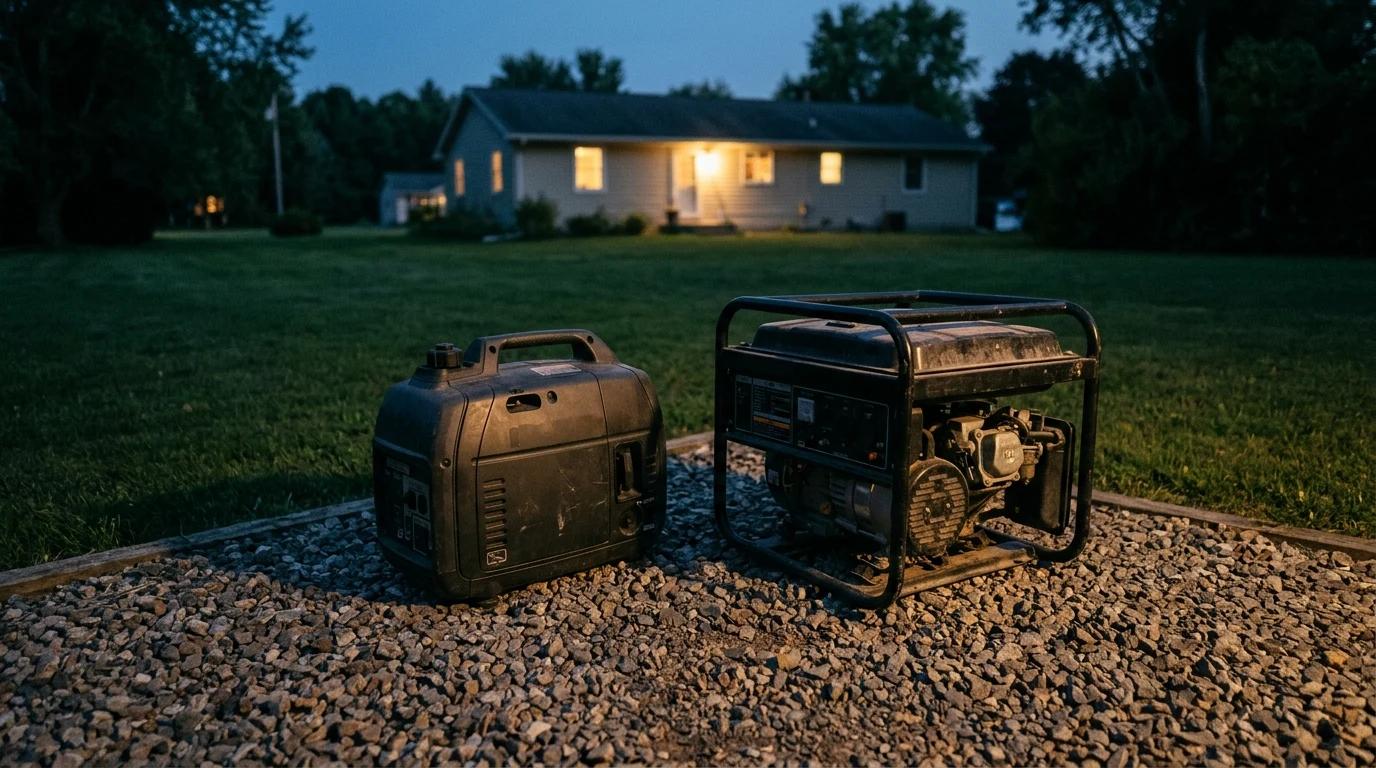
Quick answer
Choose an inverter generator if you want quiet, electronics-safe power for a fridge, router and lights; choose a conventional generator if you need 240 V for a well pump, central air or a transfer switch, or simply the most watts for your money.
#1 · Quiet inverter with real power
Westinghouse iGen5000DFc
4.6 (1,171)Inverter. 3,900 running watts, a stated 52 dBA, 120 V only.
$999.00Buy on Amazon
#2 · Light inverter for essentials
WEN DF360iX
4.4 (551)Inverter. 2,900 running watts at 49 lb, 120 V only.
$521.00Buy on Amazon
#3 · Conventional with 240 V
Westinghouse WGen5300DFcv
4.5 (1,048)Conventional. 5,300 running watts, L14-30 outlet for a transfer switch.
$579.00Buy on Amazon
#4 · Lowest-cost conventional
Westinghouse WGen3600DFcv
4.6 (239)Conventional. 3,600 running watts, 120 V outlets only.
$399.00Buy on Amazon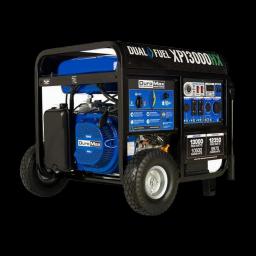
#5 · Most of a house
DuroMax XP13000HX
4.4 (1,052)Conventional. 10,500 running watts and a 50-amp outlet.
| Pick | Best for | Ready | Buy |
|---|---|---|---|
 1. Westinghouse iGen5000DFc 4.6 (1,171) | Quiet inverter with real power Inverter. 3,900 running watts, a stated 52 dBA, 120 V only. | 78 | $999.00Buy on Amazon |
 2. WEN DF360iX 4.4 (551) | Light inverter for essentials Inverter. 2,900 running watts at 49 lb, 120 V only. | 65 | $521.00Buy on Amazon |
 3. Westinghouse WGen5300DFcv 4.5 (1,048) | Conventional with 240 V Conventional. 5,300 running watts, L14-30 outlet for a transfer switch. | 71 | $579.00Buy on Amazon |
 4. Westinghouse WGen3600DFcv 4.6 (239) | Lowest-cost conventional Conventional. 3,600 running watts, 120 V outlets only. | 63 | $399.00Buy on Amazon |
 5. DuroMax XP13000HX 4.4 (1,052) | Most of a house Conventional. 10,500 running watts and a 50-amp outlet. | 72 |
Key takeaways
- An inverter generator converts its output to DC and back to AC, so the engine can slow down with the load.
- Westinghouse states 3% or less total harmonic distortion for its inverters and up to 23% for most of its open-frame generators.
- Conventional generators give more running watts per dollar, and the 240 V twist-lock outlet that a transfer switch or well pump needs.
- Both burn fuel and make carbon monoxide: outdoors only, more than 20 feet from windows, doors and vents.
The short answer
Choose an inverter generator if you want quiet, electronics-safe power for a fridge, router and lights. Choose a conventional generator if you need 240 V for a well pump, central air or a transfer switch, or the most watts for the money. Both make carbon monoxide and both belong outside.
| Inverter generator | Conventional generator | |
|---|---|---|
| How it makes power | AC to DC to clean AC | Alternator at a fixed engine speed |
| Engine speed | Follows the load | Champion says a constant 3,600 RPM |
| Harmonic distortion | Westinghouse states 3% or less | Westinghouse states up to 23% on most open frames |
| Noise, maker-stated | 52 dBA for the iGen5000DFc | 68 dBA for the WGen5300DFcv |
| 240 V outlet | Not on either inverter here | On the WGen5300DFcv and DuroMax |
| Watts for the money | Lower | Higher |
What actually differs
The electronics. Champion explains that an inverter generator converts its alternating current to direct current and back to high-quality AC. Because the inverter sets the output frequency, the engine no longer has to spin at one speed. A conventional generator, Champion says, runs at a constant 3,600 RPM whether it is powering one lamp or a full load.
Power quality. Total harmonic distortion (THD) measures how far the output strays from a smooth sine wave. Westinghouse states 3% or less for its inverters and up to 23% for most of its traditional open-frame models. WEN states under 1.2% at full load for the DF360iX. If you plan to run a laptop, a modem or a CPAP from the generator, that difference is the main reason to choose an inverter.
Noise that follows the load. Westinghouse says traditional generators make the same noise regardless of load, while inverter noise rises as you add load. At night, with only a fridge and a router running, the inverter idles down and the open frame does not.
Worth knowing: "inverter" is about power quality and noise. It does not change the carbon monoxide rule. Every generator here runs outdoors only.
What a conventional generator still does better
More watts per dollar. In our portable generators table, the conventional Westinghouse WGen5300DFcv states 5,300 running watts and the inverter Westinghouse iGen5000DFc states 3,900. The open frame is the bigger machine, and Westinghouse lists it at the lower MSRP.
240 V. A deep-well pump, central air and most transfer switches need 240 V through a four-prong L14-30 or 50-amp outlet. Westinghouse lists an L14-30R on the WGen5300DFcv and 120 V outlets only on the iGen5000DFc. WEN's DF360iX is 120 V only too. If your plan involves a transfer switch or interlock or a well pump, the conventional generator is usually the one that fits.
Surge for motors. The WGen5300DFcv states 6,500 starting watts. Motors such as a well pump draw several times their running watts for a moment, so headroom matters. Run your list through the generator sizing tool before choosing a type.
Fuel and runtime
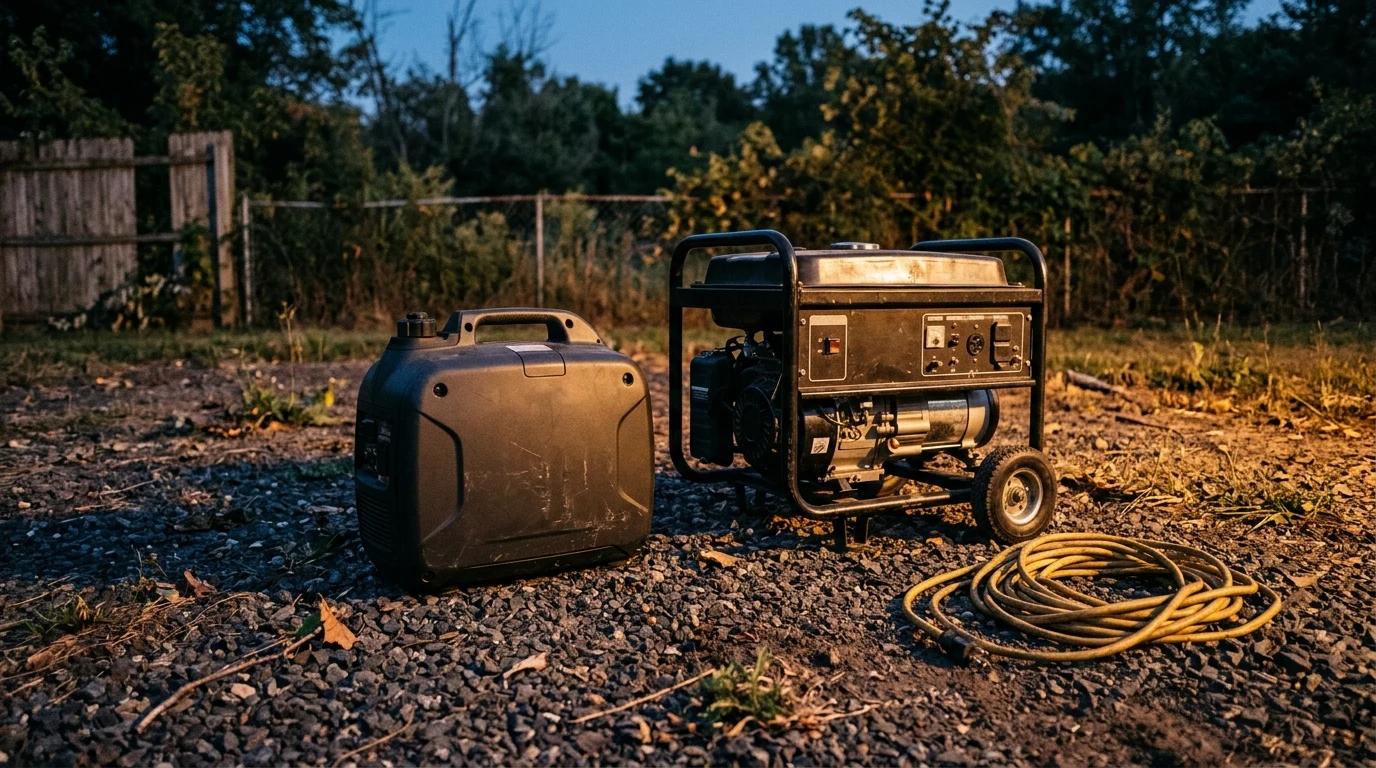
Inverters save fuel at light loads because the engine slows down. Champion says inverter runtime is typically longer than a conventional generator's at the same load. Watch how the makers quote runtime, though: Champion notes that standard generators are usually rated at half load and inverters at a quarter.
| Model | Type | Maker-stated runtime |
|---|---|---|
| Westinghouse iGen5000DFc | Inverter | 18 hours at 25% load on a 3.4-gallon tank |
| WEN DF360iX | Inverter | 5 hours at half load on 1.5 gallons, 14 hours on a 20-lb propane tank |
| Westinghouse WGen5300DFcv | Conventional | 14.5 hours at 25% load, 11 hours at 50%, on 4.7 gallons |
All three are dual fuel, so propane is an option on each. Our propane vs gas guide covers what that costs you in watts and runtime.
Can an inverter run a fridge and furnace?
Usually, yes. Champion's wattage chart puts a refrigerator at 150 to 400 running watts with up to 1,200 to start, and a 1/2 HP furnace fan at 300 to 800 running with up to 1,600 to start. Using the top of those ranges and Champion's method, total running watts plus the highest starting watts, the pair peaks at about 2,800 W. Westinghouse states 3,900 running and 5,000 starting watts for the iGen5000DFc, which covers that with room for lights and a router. The WEN's 2,900 running watts covers it too, with less to spare.
If you need more than one inverter gives, WEN sells a parallel kit to link two of its inverters, and Champion says only its inverters with ParaLINK can be paired. Two small inverters cost more than one open frame of the same output, though.
Weight and handling
Champion describes inverters as smaller and lighter than standard portable generators, and the WEN is the clearest case at a stated 49 lb. The iGen5000DFc is not light, though, at 105.8 lb dry. The open-frame WGen5300DFcv is 135.6 lb, and the DuroMax is 240 lb. Either way, you will be wheeling it more than 20 feet from the house for every outage, so wheels and a handle count.
Which to buy for an outage
- Essentials only, close neighbors, or you also camp: an inverter. The iGen5000DFc $999.00 is our pick when quiet matters, and the WEN DF360iX $521.00 when weight does.
- A 240 V well pump or a transfer switch: a conventional generator with an L14-30 outlet, such as the WGen5300DFcv $579.00.
- Most of a house, including central air: the DuroMax XP13000HX the current listing price states 10,500 running watts and a 50-amp outlet.
- Short outages, no yard, or you want silence: neither. A power station has no exhaust and runs indoors.
Rule of thumb: if every load you need plugs into a 120 V outlet, start with an inverter. If one load is wired at 240 V, start with a conventional generator.
The rule that applies to both
The CDC says to use generators only outside, more than 20 feet from windows, doors and vents, and never in a home or garage, even with doors and windows open. CPSC adds that a porch or carport is too close, and urges buyers to look for a CO shut-off. All six generators in our table state one. Keep a battery CO alarm working inside the house as well.
Which type fits your outage
- Fridge, router, lights and phones
- Inverter
- Enough watts, cleaner output and less noise through a long night.
- Neighbors a few yards away
- Inverter
- Westinghouse states 52 dBA for its inverter against 68 dBA for its open-frame 5300.
- 240 V well pump or a transfer switch
- Conventional
- The 240 V twist-lock outlet is standard on mid-size open frames and absent from both inverters here.
- Central air or most of the house
- Conventional
- 10,000-plus running watts costs far less in an open frame.
- Generator you carry to a cabin or campsite too
- Inverter
- WEN states 49 lb for the DF360iX, light enough for one person.
Questions people ask
Is an inverter generator better than a regular generator?
For electronics and noise, yes. Westinghouse states 3% or less harmonic distortion for its inverters. For raw watts and 240 V outlets per dollar, a conventional open-frame generator is the stronger buy.
Can a regular generator damage electronics?
Champion describes clean power as 3% THD or less, and Westinghouse states up to 23% for most of its open-frame models. Many appliances cope; if you power a computer or medical device, an inverter removes the doubt.
Is a power inverter the same as an inverter generator?
No. A power inverter turns battery DC into AC and has no engine. Paired with a big battery, that is a power station, which runs indoors with no exhaust. An inverter generator burns fuel and must stay outside.
Can an inverter generator run a whole house?
Not the portable inverters here. The iGen5000DFc states 3,900 running watts at 120 V, which covers essentials but not a 240 V well pump or central air.
Sources for this guide
- Champion: what is an inverter generator?
- Westinghouse: portable generator FAQ
- Westinghouse: iGen5000DFc specifications
- Westinghouse: WGen5300DFcv specifications
- WEN: DF360iX dual fuel inverter generator
- Champion: gasoline, propane and natural gas compared
- Champion: generator wattage chart
- CDC: carbon monoxide poisoning basics
- CPSC: winter storm warning on generator CO and fire risks (January 2026)
Outage Ready Editorial
We work out the arithmetic and read the maker and agency pages so you do not have to. About us.
Read next
Power Station vs Generator: Which One Fits Your Outage?
A power station suits short outages and indoor use; a generator suits long outages and heavy loads you can run 20 feet from the house.
5 min read
Quietest Portable Generator for a Power Outage
The Westinghouse iGen5000DFc is the quietest generator we list at a maker-stated 52 dBA. Here is what that number means, and the silent option.
5 min read
Propane vs Gas Generator: Is Dual Fuel Worth It?
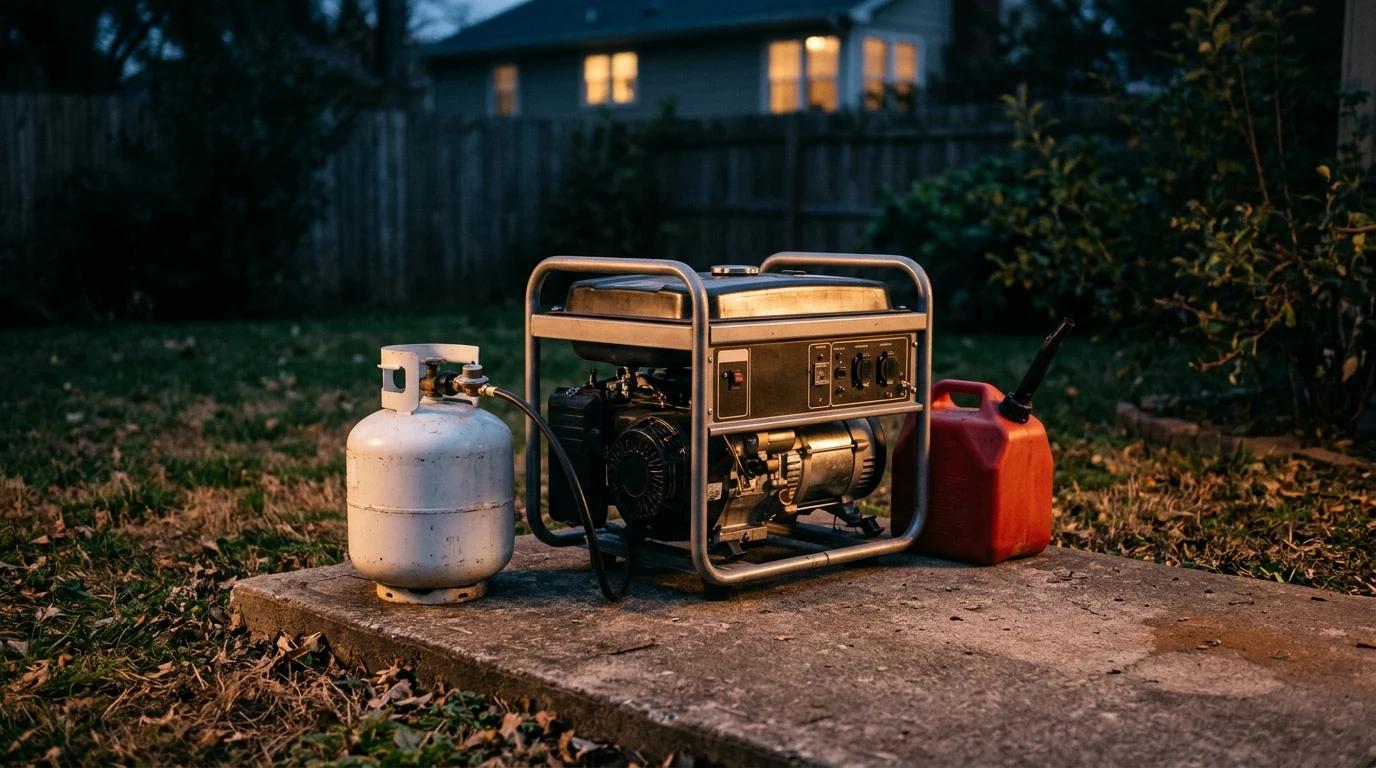
Gasoline gives the most watts per gallon; propane keeps for years. For outage backup, that usually makes dual fuel the safer buy.
5 min read