Top pick
Renogy 200W Portable Solar Panel
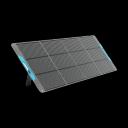
The size that makes a real difference, from a brand OutdoorGearLab recommends.
$219.99Buy on Amazon
Backup power · 5 ranked · prices checked Nov 22
The 30-second answer: The best portable solar panel for most power stations is the Renogy 200W: 25% cells at a stated 13.9 lb, and in a good day of sun it can return enough for about 7 hours of fridge time.
Top pick
The size that makes a real difference, from a brand OutdoorGearLab recommends.
Budget pick
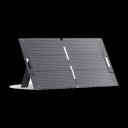
The light panel for a small station: BLUETTI states 100 W and 23.4% cells at 10.9 lb, and BLUETTI sells it directly.
Skip this
Its Amazon listing now opens the EcoFlow 110W panel, marked currently unavailable, so there is no 220W listing to link.
Figures are the makers' stated values.
| Spec | #1  Renogy 200W Portable Solar Panel 4.5 (986) stars on Amazon | #2  Renogy 400W Portable Solar Panel 4.3 (276) stars on Amazon | #3  BLUETTI 100W Portable Solar Panel 4.5 (1,226) stars on Amazon | #4  FlexSolar 100W Foldable 4.4 (365) stars on Amazon | #5  EcoFlow 160W Portable Solar Panel 4.6 (97) stars on Amazon |
|---|---|---|---|---|---|
| Buy | Buy on Amazon$219.99 | Buy on Amazon$469.99 | Buy on Amazon$198.99 | No price verified | No price verified |
| Ready Score | 68 | 71 | 58 | 61 | 67 |
| Rated Watts | 200 W | 400 W | 100 W | 100 W | 160 W |
| Weight (lb) | 13.9 lb | 16.1 lb | 10.9 lb | 4.1 lb | 12.3 lb |
| Cell Efficiency (%) | 25% | 25% | 23.4% | 23% | 25% |
| Connector | MC4, USB-C, USB-A | MC4 | Not stated | USB-C, USB-A, DC with 4-in-1 cable | MC4 |
| Water Rating | Not stated | Not stated | IP67 | IP67 | IP68 |
| Best for | most power stations | large stations | a small power station | Best low-cost panel for small stations | Best compact panel for EcoFlow owners |
| Why it is here | The size that makes a real difference, from a brand OutdoorGearLab recommends. Renogy states 25% efficiency, and the panel charges phones directly through USB-C as well. | Double the watts of our top pick at a stated 16.1 lb, in a 16-fold blanket. Choose it for a 2 kWh station or bigger, since a small station cannot take this much input. | The light panel for a small station: BLUETTI states 100 W and 23.4% cells at 10.9 lb, and BLUETTI sells it directly. Pick it when carrying matters more than watts. | The cheap way to keep a small station and your phones topped up, at a stated 4.1 lb. On a 288 Wh station it matters; on a 2 kWh unit it barely registers. | A middle size with an IP68 rating and a built-in stand. Buy it if 200 W panels are awkward to store, and you already own an EcoFlow station. |
| The trade-off | OutdoorGearLab notes it is not the lightest and not the highest waterproof rating | Stock can run low | 100 W is half the Renogy 200W's output | 100 W returns too little for a fridge station | MC4 only, with no direct phone charging |
| Pros |
|
|
|
|
|
Prices checked November 22, 2026 and may have changed. A Buy button appears only where Amazon showed a live price; specs are what each maker states, and Ready Score is a reading aid, not the ranking.
The number on the panel is a lab rating. OutdoorGearLab says it found significant differences between claimed and actual capacity across the panels it tested. We plan on 75% of the rating in good sun.
So estimate: 200 W × 0.75 × 5 hours of good sun is about 750 Wh a day. After inverter loss, that runs a fridge at its 86 W average for about 7 hours. The five hours is our assumption; winter or overcast days can be far less.
Rule of thumb: one 200 W panel stretches a battery. It does not replace one. Buy the power station first.
A station's solar input is capped, and the plug has to fit. Check three things before you buy:
Solar suits outages that last days, when no generator fuel is at hand or you live where a generator cannot go. For a single overnight outage, it adds nothing: the sun is down.
Portable panels work during an outage because they feed the station directly. Keep them out in the open, angled at the sun, and bring them in before a storm.
For a long outage, about 200 W per 1,000 Wh of battery is a sensible start. At 75% output and 5 hours of good sun, 200 W returns about 750 Wh a day. Those are our assumptions, so winter days return less.
No. It needs a power station in between. A 200 W panel returns about 750 Wh on a good day, which runs a fridge at its 86 W average for about 7 hours through the station.
No. Most panels here end in MC4, which may need an adapter. Jackery panels use DC8020. Check the connector and your station's solar input limit before you buy.