Top pick
Anker Zolo 20,000mAh 30W
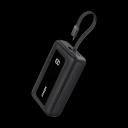
The easy default: a built-in USB-C cable, a stated 4 iPhone 15 charges, and 12.45 oz.
$32.99Buy on Amazon
Backup power · 6 ranked · prices checked Nov 22
The 30-second answer: The best power bank for a power outage is the Anker Zolo 20,000mAh: about 74 Wh, a built-in USB-C cable and, Anker states, up to 4 iPhone 15 charges. Buy two instead of one giant no-name brick.
Top pick
The easy default: a built-in USB-C cable, a stated 4 iPhone 15 charges, and 12.45 oz.
Budget pick
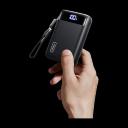
The lowest-priced 20,000 mAh bank here, and one of the best sellers.
Skip this
An honest 90,000 mAh is about 333 Wh, which is over the FAA's 160 Wh limit, and no reputable maker we checked sells this format.
Figures are the makers' stated values.
| Spec | #1 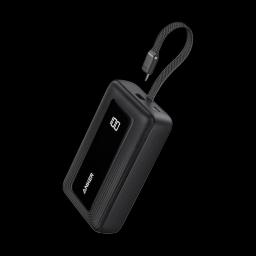 Anker Zolo 20,000mAh 30W 4.4 (14,955) stars on Amazon | #2  INIU P512 20,000mAh 22.5W 4.6 (28,853) stars on Amazon | #3  Anker 20,000mAh 87W Built-In Cable 4.5 (10,571) stars on Amazon | #4  INIU P63-E1 25,000mAh 100W 4.4 (5,038) stars on Amazon | #5  Anker 25,000mAh 165W with Retractable Cable 4.4 (13,022) stars on Amazon | #6  Anker Prime 26,250mAh 300W 4.6 (1,872) stars on Amazon |
|---|---|---|---|---|---|---|
| Buy | Buy on Amazon$32.99 | Buy on Amazon$25.60 | Buy on Amazon$55.99 | Buy on Amazon$56.99 | Buy on Amazon$91.19 | Buy on Amazon$159.99 |
| Ready Score | 63 | 71 | 60 | 64 | 49 | 69 |
| Max Output (W) | 30 W | 22.5 W | 87 W | 100 W | 165 W | 300 W |
| Ports | Built-in USB-C cable | Built-in USB-C cable plus 2 USB-C | Built-in USB-C, 1 USB-C, 1 USB-A | 2 USB-C, 1 USB-A | 2 built-in USB-C, 1 USB-C, 1 USB-A | 2 USB-C, 1 USB-A |
| Weight (oz) | 12.45 oz | 11 oz | 15.5 oz | 13.8 oz | Not stated | 21.2 oz |
| Recharge Input (W) | 20 W | Not stated | 65 W | Not stated | Not stated | 250 W |
| Capacity (mAh) | 20,000 mAh | 20,000 mAh | 20,000 mAh | 25,000 mAh | 25,000 mAh | 26,250 mAh |
| Best for | most households | Best low-cost pocket bank | a laptop and a phone | Best small 25,000 mAh bank | several devices at once | fast recharge between outages |
| Why it is here | The easy default: a built-in USB-C cable, a stated 4 iPhone 15 charges, and 12.45 oz. Buy two and you have the whole family's phones covered for a typical outage. | The lowest-priced 20,000 mAh bank here, and one of the best sellers. INIU states 4 full phone charges and about 11 oz. It is phone-only: 22.5 W will not charge a laptop in any useful way. | Same capacity as the Zolo with nearly three times the output: 65 W on one port charges a laptop. Anker states a 1.5-hour recharge on a 65 W charger, a real plus when the power flickers back. | The compact way to get 25,000 mAh and 100 W: a stated 13.8 oz, sold by Amazon. Compact for 25,000 mAh, but it has no built-in cable. | A family bank: three 100 W USB-C paths plus USB-A, with one retractable cable and one that doubles as a strap. Anker states it fits the 100 Wh flight limit. | The premium choice, for one thing that actually helps in an outage: Anker states 50% recharge in 13 minutes on dual inputs. If the grid flickers back for 20 minutes, this one fills. Overkill for phones alone. |
| The trade-off | 30 W output is too low for most laptops | 22.5 W output limits it to phones | 15.5 oz is a bit heavier than the Zolo | No built-in cable | Costs about three times the Zolo | 600 g on the listing, the heaviest here |
| Pros |
|
|
|
|
|
|
Prices checked November 22, 2026 and may have changed. A Buy button appears only where Amazon showed a live price; specs are what each maker states, and Ready Score is a reading aid, not the ranking.
Multiply mAh by 3.7 and divide by 1,000 to get watt-hours, then expect to lose some in conversion. So 20,000 mAh is about 74 Wh. Anker states up to 4 iPhone 15 charges from its Zolo, which is what most people need for a two-day outage.
Keep one in the bag and one by the bed. Two banks also let you charge two phones without taking turns.
Rule of thumb: a person's phone for 3 days is about 20,000 mAh. A laptop or a router moves you up to 25,000 mAh.
Airlines cap you at 100 Wh per battery without approval, per the FAA and TSA, which is about 27,000 mAh (up to 160 Wh is allowed only with airline approval). That is why reputable makers stop there. Past that point you are looking at a power station, which is often better value per watt-hour anyway.
Be careful of listings claiming 60,000 to 90,000 mAh from unfamiliar brands. INIU notes that real 20,000 mAh takes dense cells at about 11 oz, so an honest 90,000 mAh bank would weigh around 3 lb and hold about 333 Wh, which is over the FAA's 160 Wh limit and unlike anything a reputable maker sells in this form.
A phone's own charging limit is usually the bottleneck, so high output buys little for it. A laptop benefits from 65 W or more.
A router is a different job: most need 12 V DC, and a USB-C bank needs a matching cable or trigger. See router and modem backup before you plan on this. Ready.gov lists a power bank among basic outage alternatives, and this is the right tool for phones.
Anker states up to 4 iPhone 15 charges from its 20,000 mAh Zolo, and INIU states 4 full phone charges from its own. Bigger phones get fewer.
Only if the router's voltage is supported, usually with a 12 V cable. A router draws about 20 W, so 74 Wh is roughly 3 hours at best. A router UPS is the better tool.
Be skeptical. INIU notes a real 20,000 mAh takes dense cells at about 11 oz, so a real 60,000 mAh would weigh over 2 lb. Reputable makers stop around 27,000 mAh for flight rules.