Top pick
Wayne ESP25n
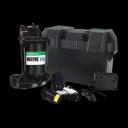
The strong, simple add-on: Wayne states 1,500 gallons an hour at 10 feet, a top-suction design against clogs, and a battery case with an audible alarm.
$281.18Buy on Amazon
Home systems · 5 ranked · prices checked Nov 22
The 30-second answer: The best battery backup sump pump for most homes is the Wayne ESP25n: Wayne states 1,500 gallons an hour at 10 feet of lift, and it adds to your existing pump. Budget for the battery, which is sold separately.
Top pick
The strong, simple add-on: Wayne states 1,500 gallons an hour at 10 feet, a top-suction design against clogs, and a battery case with an audible alarm.
Value pick
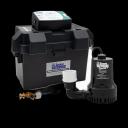
A compact battery backup that fits tight pits, with a maker-stated 1,730 gallons an hour at 10 feet.
Budget pick
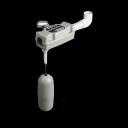
A water-powered backup that runs on city water, with no battery to wear out or run down.
Skip this
Rated 4.0 on the live listing, below our 4.3-star minimum; the SumpJet covers water-powered backup.
Figures are the makers' stated values.
| Spec | #1 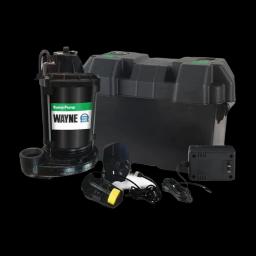 Wayne ESP25n 4.5 (1,543) stars on Amazon | #2 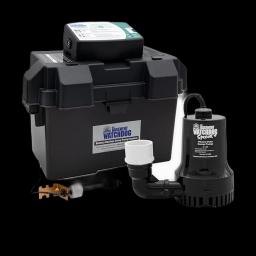 Basement Watchdog Special 4.5 (327) stars on Amazon | #3 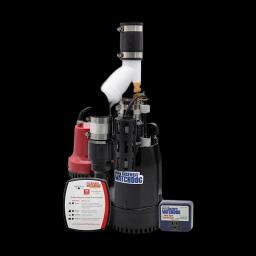 Basement Watchdog Combo CITE-33 4.4 (250) stars on Amazon | #4 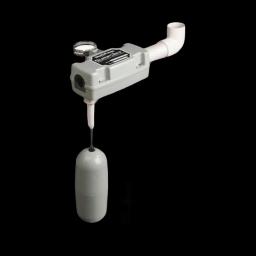 Liberty SumpJet SJ10 4.6 (1,366) stars on Amazon | #5  Zoeller Aquanot 508 4.4 (192) stars on Amazon |
|---|---|---|---|---|---|
| Buy | Buy on Amazon$281.18 | Buy on Amazon$279.00 | Buy on Amazon$379.00 | Buy on Amazon$238.65 | Buy on Amazon$444.98 |
| Ready Score | 63 | 80 | 58 | 52 | 39 |
| Flow (GPH at 10 ft) | 1,500 GPH | 1,730 GPH | 1,500 GPH on backup | Not stated | Not stated |
| Power Source | 12 V battery | 12 V battery | 120 V primary, 12 V backup | City water at 20 to 100 psi | 12 V battery |
| Battery Included | No | No | No | No, none needed | No |
| Alarm | Yes | Yes, control panel warning | Yes | Not stated | Not stated |
| Best for | most homes | narrow sump pits | Best combo if your main pump is old | Best with no battery to maintain | Best US-built premium backup |
| Why it is here | The strong, simple add-on: Wayne states 1,500 gallons an hour at 10 feet, a top-suction design against clogs, and a battery case with an audible alarm. Budget for the separate 12 V battery. | A compact battery backup that fits tight pits, with a maker-stated 1,730 gallons an hour at 10 feet. Its panel tells you what is wrong in plain language, which is a real help on a system you rarely look at. | Replaces your primary pump and adds backup in one preassembled unit, which suits a pump near the end of its life. The maker states 3,100 gallons an hour on primary and 1,500 on backup at 10 feet. | A water-powered backup that runs on city water, with no battery to wear out or run down. It needs 20 to 100 psi of municipal pressure, so it is useless on a well, and installation takes a plumber. | The premium brand's backup: Zoeller says it is hand built and tested in the USA, with noncorrosive construction and an integrated check valve. Buy it for the build, not for the flow, which the listing does not give at 10 feet. |
| The trade-off | Battery sold separately | Sold by a third-party seller | Battery sold separately | Requires municipal water at 20 to 100 psi | Sold by a third-party seller |
| Pros |
|
|
|
|
|
Prices checked November 22, 2026 and may have changed. A Buy button appears only where Amazon showed a live price; specs are what each maker states, and Ready Score is a reading aid, not the ranking.
Rule of thumb: compare flow at 10 feet of lift, not the bigger zero-lift number on the box.
Wayne states 2,700 gallons an hour at 0 feet, and only 1,500 at 10. Most basements lift about that far, so use the 10-foot figure. Wayne also states up to 10,000 gallons on one charge with its recommended 75 Ah battery.
Consumer Reports says most battery models can run for days on a single charge when pumping intermittently, but a heavy storm drains them faster. A larger battery buys time, and replacing an old one is the maintenance people forget. Ask the maker how often.
You could run your normal pump from a power station or generator. Champion puts a 1/3 HP sump at up to 800 W running and up to 1,600 W at start, so check that your inverter can handle it. A separate pump also protects you when the main pump fails with the power on, which a power station cannot do. FEMA's basement flood guidance calls a battery backup pump an inexpensive safeguard against basement flooding.
Consumer Reports says most battery models can run for days on a single charge when pumping intermittently. Wayne states up to 10,000 gallons on one charge with its recommended 75 Ah battery. Heavy inflow drains it faster.
No. They need municipal water pressure, and Consumer Reports says they suit homes on city water. A well pump stops when the power does.
Often, if the inverter handles the start. Champion puts a 1/3 HP sump at up to 800 W running and 1,600 W at start. That leaves you unprotected if the pump itself fails, which a separate backup covers.