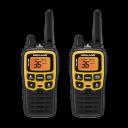
The walkie-talkie pair to keep in an outage kit: license-free FRS with NOAA weather scan and alert, and Midland states it also runs on three AAA alkaline cells when the rechargeable pack is flat.
$79.99Buy on Amazon
Stay informed · 6 ranked · prices checked Nov 22
The 30-second answer: The best walkie-talkies for emergencies are license-free FRS radios with NOAA weather alerts that can also run on store-bought batteries, like the Midland T61VP3. Expect about a mile between houses, not the 30-plus miles on the box.
The walkie-talkie pair to keep in an outage kit: license-free FRS with NOAA weather scan and alert, and Midland states it also runs on three AAA alkaline cells when the rechargeable pack is flat.
Value pick
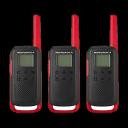
Three radios in one box for a household that splits up during an outage, with NOAA weather alerts and dual power, from a long-running walkie-talkie line.
Budget pick
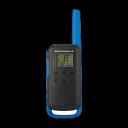
The lowest-cost pair with NOAA weather alerts and dual power: a plain Talkabout that does the outage basics and little else.
Skip this
A GMRS radio, so it needs an FCC license; this page lists license-free FRS radios only.
Figures are the makers' stated values.
| Spec | #1 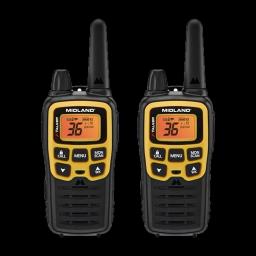 Midland T61VP3 X-Talker FRS Walkie-Talkie 2-Pack 4.4 (1,597) stars on Amazon | #2  Motorola Talkabout T475 Extreme 2-Pack 4.3 (887) stars on Amazon | #3 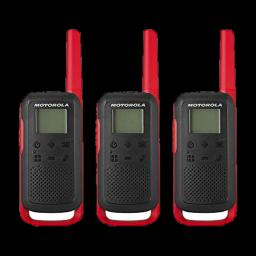 Motorola Talkabout T210TP 3-Pack 4.5 (452) stars on Amazon | #4 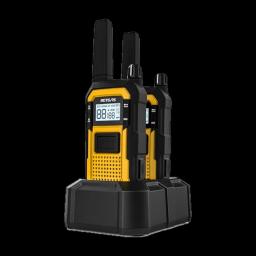 Retevis RB48 Rugged FRS Walkie-Talkie 2-Pack 4.6 (949) stars on Amazon | #5 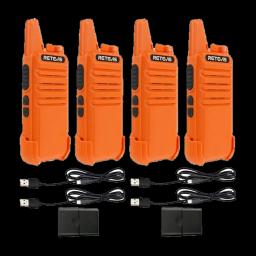 Retevis RT22 Rechargeable FRS Walkie-Talkie 4-Pack 4.5 (4,755) stars on Amazon | #6 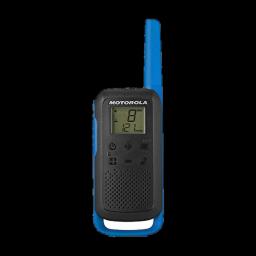 Motorola Talkabout T270 2-Pack 4.3 (164) stars on Amazon |
|---|---|---|---|---|---|---|
| Buy | Buy on Amazon$79.99 | Buy on Amazon$79.99 | Buy on Amazon$59.49 | Buy on Amazon$84.99 | Buy on Amazon$47.99 | Buy on Amazon$38.24 |
| Ready Score | 71 | 69 | 84 | 53 | 61 | 74 |
| NOAA Alert | Yes, weather scan and alert, per Midland | Yes, NOAA weather radio and alerts, per the listing | Yes, NOAA weather radio and alerts, per the listing | Yes, NOAA weather, per the listing | No | Yes, NOAA weather radio and alerts, per the listing |
| Backup Batteries | Yes, 3 AAA alkaline cells, per Midland | Yes, dual power: rechargeable pack or alkaline cells, per the listing | Yes, dual power: rechargeable pack or alkaline cells, per the listing | Not stated | Not stated | Yes, dual power: rechargeable pack or alkaline cells, per the listing |
| Water Rating | Not stated | IPx4, per the listing | Not stated | IP67, floats, per Retevis | Not stated | Not stated |
| Radios in Pack | 2 radios | 2 radios | 3 radios | 2 radios | 4 radios | 2 radios |
| Battery | Rechargeable AVP14 pack, 6.6 h on high power at 90-5-5 use, per Midland | 800 mAh NiMH, up to 12 h, per the listing | 800 mAh, about 18 h, per the listing | 2,000 mAh, up to 20 h, USB-C, per Retevis | 1,000 mAh, 10 h of continuous use, USB-C, per the listing | 800 mAh, about 14 h, per the listing |
| Channels | 36 channels, 121 privacy codes, per Midland | 22 channels, 121 privacy codes | 22 channels, 121 privacy codes | 22 FRS channels | 22 FRS channels | 22 channels, 121 privacy codes |
| Best for | most households | a built-in flashlight | three people | floods and wet storms | four people on a budget | a cheap pair with weather alerts |
| Why it is here | The walkie-talkie pair to keep in an outage kit: license-free FRS with NOAA weather scan and alert, and Midland states it also runs on three AAA alkaline cells when the rechargeable pack is flat. | The pick if you want the radio to double as a light: NOAA weather alerts, a built-in flashlight and an IPx4 splash rating, with dual power so it is not stuck when the pack runs down. | Three radios in one box for a household that splits up during an outage, with NOAA weather alerts and dual power, from a long-running walkie-talkie line. | The rugged pick for floods and hurricanes: Retevis states IP67 waterproofing, that the radio floats, and a 2,000 mAh battery good for up to 20 hours, with USB-C charging. | The cheapest way to put a radio in four hands: slim 3.8 oz FRS radios with USB-C charging and hands-free VOX. | The lowest-cost pair with NOAA weather alerts and dual power: a plain Talkabout that does the outage basics and little else. |
| The trade-off | Midland states 6.6 hours per charge on high power at typical use, so spares matter in a long outage | Rating sits at 4.3, lower than the Midland | No water rating stated | Retevis does not state an alkaline-cell option, so it depends on its pack | No NOAA weather channels listed | Fewer reviews than the other picks |
| Pros |
|
|
|
|
|
|
Prices checked November 22, 2026 and may have changed. A Buy button appears only where Amazon showed a live price; specs are what each maker states, and Ready Score is a reading aid, not the ranking.
The FCC licenses FRS by rule, so anyone can use these radios without applying for anything. All 22 FRS channels are shared with GMRS, which does need an individual license. That makes FRS the only walkie-talkie the whole family, including the kids and the neighbor, can pick up and use legally the day the power goes out.
FCC rules cap FRS at 2 watts on most channels and 0.5 watts on channels 8 to 14, with a fixed antenna. Every FRS radio works within the same limits, so a higher price buys battery, toughness and alerts, not reach. The full licensing comparison is in FRS vs GMRS.
Rule of thumb: plan on about a mile between houses and less through buildings. The "up to 32 miles" on the box assumes a clear line of sight from high ground.
Pick a channel and privacy code with your household and write it on the radios. Then test the range from each house you will call before a storm, because terrain and walls set the real number. Charge the packs monthly, or keep them on a power bank.
Not for FRS radios. The FCC licenses the Family Radio Service by rule, so anyone may use them. GMRS radios, which share the same channels at higher power, need an individual FCC license.
Usually about a mile between houses and less through buildings and trees. OutdoorGearLab measured most FRS radios far below their box claims, because the FCC power cap and fixed antenna limit every model the same way.
Yes. FRS radios talk directly to each other with no tower or network, which is why they are useful in an outage. They only reach other radios nearby, so they do not replace a weather radio for news.
Yes, on the shared channels. Midland notes its GMRS mobile radios cannot use FRS channels 8 to 14, so pick a channel from 1 to 7 or 15 to 22 if a GMRS user is in the group.