Guide
Does a Gas Fireplace Work Without Power? Battery Backup
Outage Ready Editorial · Updated November 21, 2026 · 5 min read
Quick answer
A standing-pilot gas fireplace works without power. Many electronic-ignition fireplaces have a battery backup pack: Heat & Glo says IntelliFire takes two D cells and IntelliFire Plus four AA. Insert them only in an outage, set the control to ON, and run a battery CO alarm.
Key takeaways
- A standing-pilot gas fireplace lights with no power at all.
- Heat & Glo says IntelliFire takes two D cells and IntelliFire Plus takes four AA for outage backup.
- Insert the cells with correct polarity, set the control to ON, and remove them when power returns.
- Keep vents clear of snow, the glass barrier on, and a battery CO alarm near sleeping areas.
The short answer
A gas fireplace with a standing pilot works in a power outage, because the pilot needs no electricity. Many newer fireplaces use intermittent pilot ignition, which needs power to spark, but several makers fit a battery backup pack for exactly this: Heat & Glo says IntelliFire systems take two D-cell batteries and IntelliFire Plus systems take four AA. Put the batteries in only when the power is out, set the control to ON, and keep a battery carbon monoxide alarm running.
Which kind of fireplace do you have?
| Ignition type | Works with no power? | What it needs | Source |
|---|---|---|---|
| Standing pilot (millivolt) | Yes | Nothing extra | Heat & Glo, Majestic |
| IntelliFire (IPI) | With its backup pack | Two D cells | Heat & Glo, Majestic |
| IntelliFire Plus (IPI Plus) | With its backup pack | Four AA cells | Heat & Glo, Majestic |
| IPI Touch | With its backup pack | Four AA cells | Majestic |
| Electronic ignition with no battery pack | Usually no | Check the manual | Owner's manual |
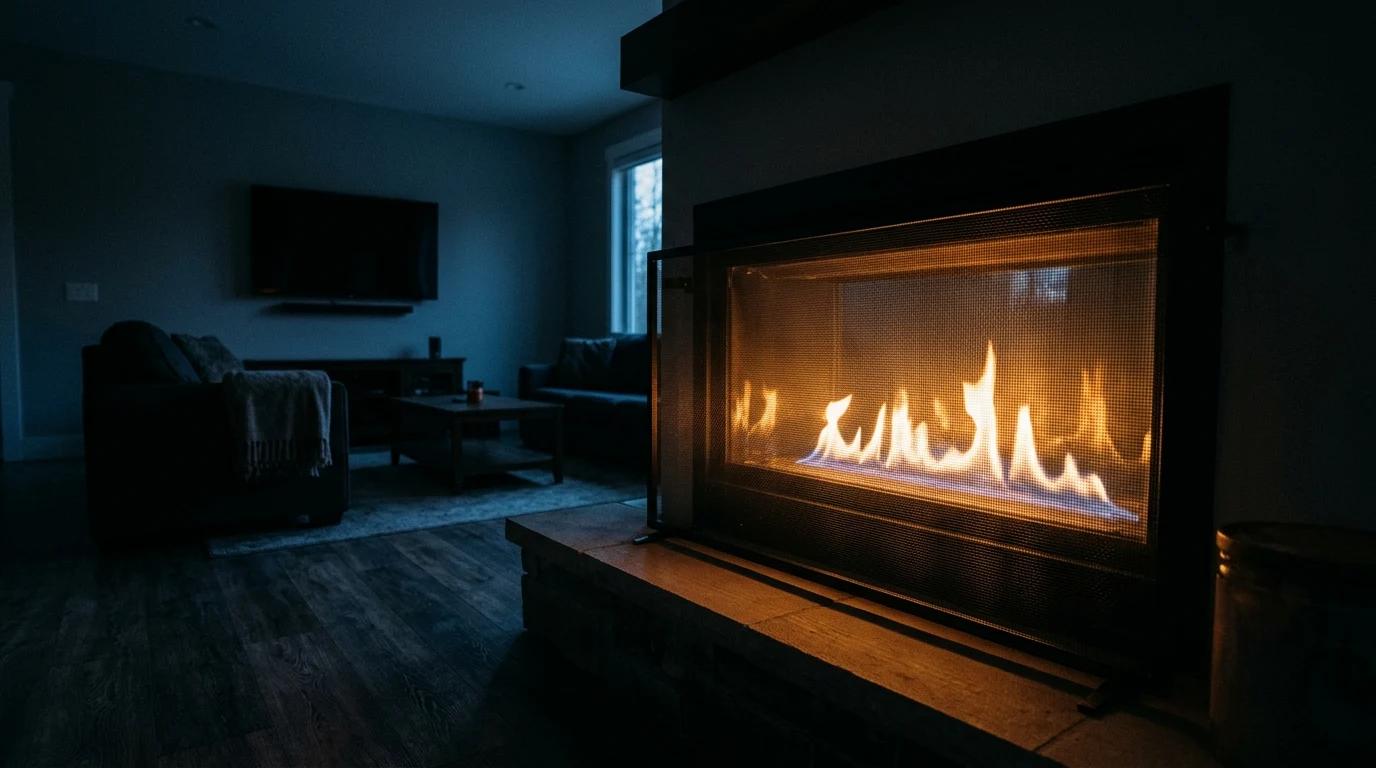
A standing pilot burns all the time, so you will usually see a small flame behind the glass even when the fireplace is off. If there is none, and the fireplace sparks when you switch it on, it has some form of electronic ignition. The owner's manual names the system; Heat & Glo, Heatilator and Majestic all point you there for the exact battery size.
Quick check: a small flame burning when the fireplace is off means a standing pilot.
How to run it on the battery backup
These steps come from Hearth & Home Technologies' brands (Heat & Glo, Heatilator, Majestic). Other makers differ, so follow your own manual.
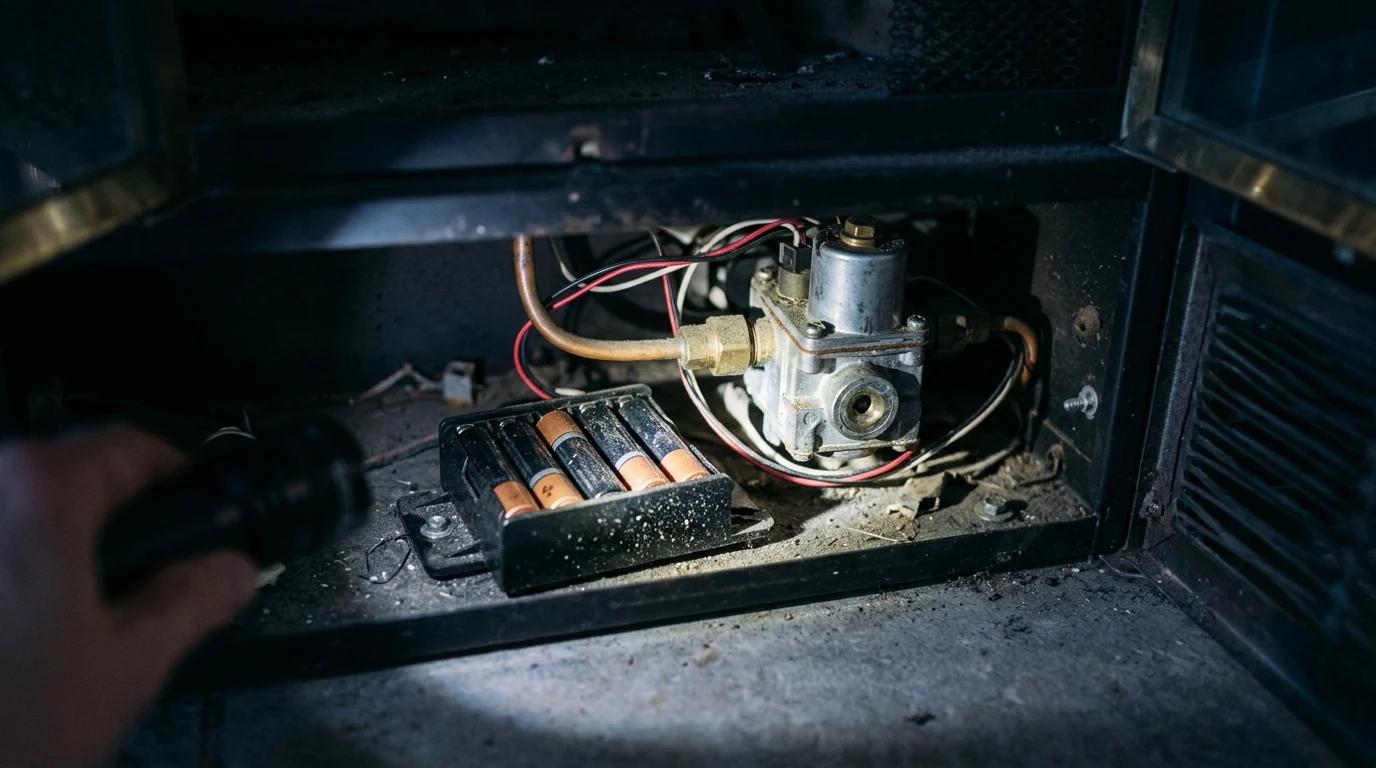
- Find the battery pack. Heat & Glo's TIARII manual says a factory-installed pack sits in the control cavity of the appliance, behind the lower front.
- Insert the cells the right way round. That manual warns that battery polarity must be correct or module damage will occur.
- Set the control. Heat & Glo and Majestic say that with a wireless remote or display wall switch, you slide the control box switch to ON, not OFF or REMOTE, so the fireplace runs without power. Some newer models keep the remote working on battery, so check yours.
- Go easy on the extras. To preserve battery life, the TIARII manual says not to use the HI/LO flame or thermostat options.
- Take the batteries out afterwards. Heat & Glo says battery life suffers from the appliance's temperatures, so remove them once power returns and keep them for next time.
What to keep in the drawer
Buy the cells now, not during the storm, and label them for the fireplace. The Hearth & Home pages we read name the size but not the chemistry. Alkaline cells are the safe default; NiMH rechargeables run at a lower voltage, so use them only if your manual allows.
Remember that a fireplace warms one room, so plan to gather there. The backup pack exists to light and run the flame; your manual says which extras, such as a blower or accent lights, still need house power.
Safety: carbon monoxide
A vented gas fireplace sends its exhaust outside, but only if the vent is clear and the appliance is maintained:
- NFPA says to have fuel-burning heating equipment and chimneys inspected by a professional every year before cold weather sets in.
- During and after a snowstorm, NFPA says to make sure vents for the furnace, dryer, stove and fireplace are clear of snow.
- CDC says to make sure gas appliances are vented properly and to install battery-operated or battery back-up CO detectors near every sleeping area.
A plug-in alarm with no battery goes dark in an outage, just when the fireplace, a generator or a camp stove comes out. The Kidde COBD10 has a 10-year built-in battery and a display. If any CO alarm sounds, NFPA says to move to fresh air outdoors or by an open window or door, account for everyone, and call for help from there. Our guide to a carbon monoxide detector beeping decodes each pattern.
If you smell gas: NFPA says do not light the appliance; leave the home and call the fire department or gas company.
Vent-free gas logs and fireplaces are different
Everything above assumes a vented fireplace, which sends its exhaust outside. A vent-free gas fireplace or set of gas logs burns in the room and releases its combustion products there, so it is closer to an unvented heater than to a sealed fireplace. NFPA's heating tips say all fuel-burning equipment should be vented to the outside to avoid carbon monoxide poisoning. If yours is vent-free, follow its manual's room-size and ventilation rules exactly, and treat the CO alarm as essential rather than optional. CPSC's 2013 statement also noted that the unvented gas fireplace standard had not yet been updated for glass-front burns.
Safety: the glass and the flood rule
The glass front gets very hot. In 2013 CPSC said the ANSI standard for vented gas fireplaces was set to require, from January 2015, a protective barrier wherever the glass front exceeds 172°F, and the TIARII manual says its barrier shall be installed. Keep the screen on, keep children back, and keep anything that burns well away: NFPA's rule is three feet.
If your fireplace has been under water from a flood, hurricane or leak, Heat & Glo and Majestic say not to use it. Call the dealer, and have a qualified technician replace any gas control that has been submerged, as the manual requires.
When the fireplace is not enough
If the fireplace cannot keep one room comfortable, look at running a gas furnace in a power outage or an indoor-rated propane heater, and read how to heat your home without power before you choose.
What your fireplace needs
- Standing pilot, flame always on
- Nothing extra
- Heat & Glo and Majestic say it works without electricity.
- IntelliFire ignition
- Two D cells
- The backup pack lights the pilot in an outage.
- IntelliFire Plus or IPI Touch
- Four AA cells
- Same backup pack idea with smaller cells.
- Fireplace has been under water
- Do not use it
- Heat & Glo and Majestic say call the dealer first.
Questions people ask
Will my gas fireplace work if the power goes out?
Yes if it has a standing pilot. If it has electronic ignition, it needs a battery backup pack; Heat & Glo, Heatilator and Majestic fit one to many IntelliFire models.
What batteries does a gas fireplace backup take?
Heat & Glo says IntelliFire uses two D cells and IntelliFire Plus uses four AA; Majestic adds that IPI Touch uses four AA. Check your owner's manual for your model.
Should I leave the batteries in all the time?
No. Heat & Glo and Heatilator say batteries are only for outages, because the appliance's heat shortens their life. Remove them when power returns.
Does a gas fireplace need a carbon monoxide alarm?
Any fuel-burning appliance does. CDC says to install battery-operated or battery back-up CO detectors near every sleeping area and to make sure gas appliances are vented properly.
Sources for this guide
- Heat & Glo: Using your fireplace or stove during a power outage
- Heatilator: Battery backup systems for gas fireplaces
- Majestic: Operating your fireplace during a power outage
- Heat & Glo: TIARII IPI owner's manual
- CPSC: Chairman's statement on glass fronts of vented gas fireplaces (2013)
- NFPA: Carbon monoxide safety tip sheet
- NFPA: Heating safety tip sheet
- CDC: Carbon monoxide poisoning basics
Outage Ready Editorial
We work out the arithmetic and read the maker and agency pages so you do not have to. About us.
Read next
How to Heat Your Home Without Power, Safely
Heat one small room, with a wood stove or an indoor-rated heater if you have one, and never with an oven, a camp stove or a generator inside.
5 min read
What to Do When the Power Goes Out: First-Hour Checklist
A calm, ordered first hour: light, breaker, fridge door, surge protection, then a plan for food, heat and medical devices.
5 min read