Guide
How to Heat Your Home Without Power, Safely
Outage Ready Editorial · Updated November 2, 2026 · 5 min read
Quick answer
The safest way to heat your home without power is to gather everyone in one small room, dress in layers, and add heat only from a source rated for indoor use, with a battery carbon monoxide alarm running. Never heat with a gas oven, a camp stove, a grill or a generator inside.
Key takeaways
- Heat one small room and dress in layers before adding any fuel.
- Never heat with a gas oven, camp stove, grill or a generator inside.
- Buy a battery CO alarm before any fuel heater; an indoor-rated propane heater also needs its stated vent and an awake adult.
- A 1,024 Wh power station runs a 1,500 W space heater for only about 35 minutes.
Heat one room, not the whole house
The safest way to heat your home without power is to gather everyone in one small room, dress in layers, and add heat only from a source rated for indoor use, with a battery carbon monoxide alarm running. If it gets too cold to do that, leave for a warming location. Ready.gov advises going to a community location with power when heat or cold is extreme.
Trying to heat a whole house is what pushes people toward dangerous choices. One room needs a fraction of the heat.
Never heat with these: a gas stove or oven, a camp stove, a charcoal grill, or a generator inside. CDC and Ready.gov are clear on all of them.
Your options, ranked
| Option | Our read | Key rule |
|---|---|---|
| Layers, one room, a tent indoors | Start here | Stay dry |
| Wood stove or fireplace you already have | Good if maintained | Never go to bed with a fire burning, per Consumer Reports |
| Indoor-rated propane heater | Emergency use | Vent open, awake, CO alarm on |
| Furnace blower on backup power | Good if wired for it | Needs a proper connection |
| Electric heater on a battery | Short bursts only | The arithmetic below |
| Oven, camp stove, grill | Never | Carbon monoxide |
Start with no fuel at all
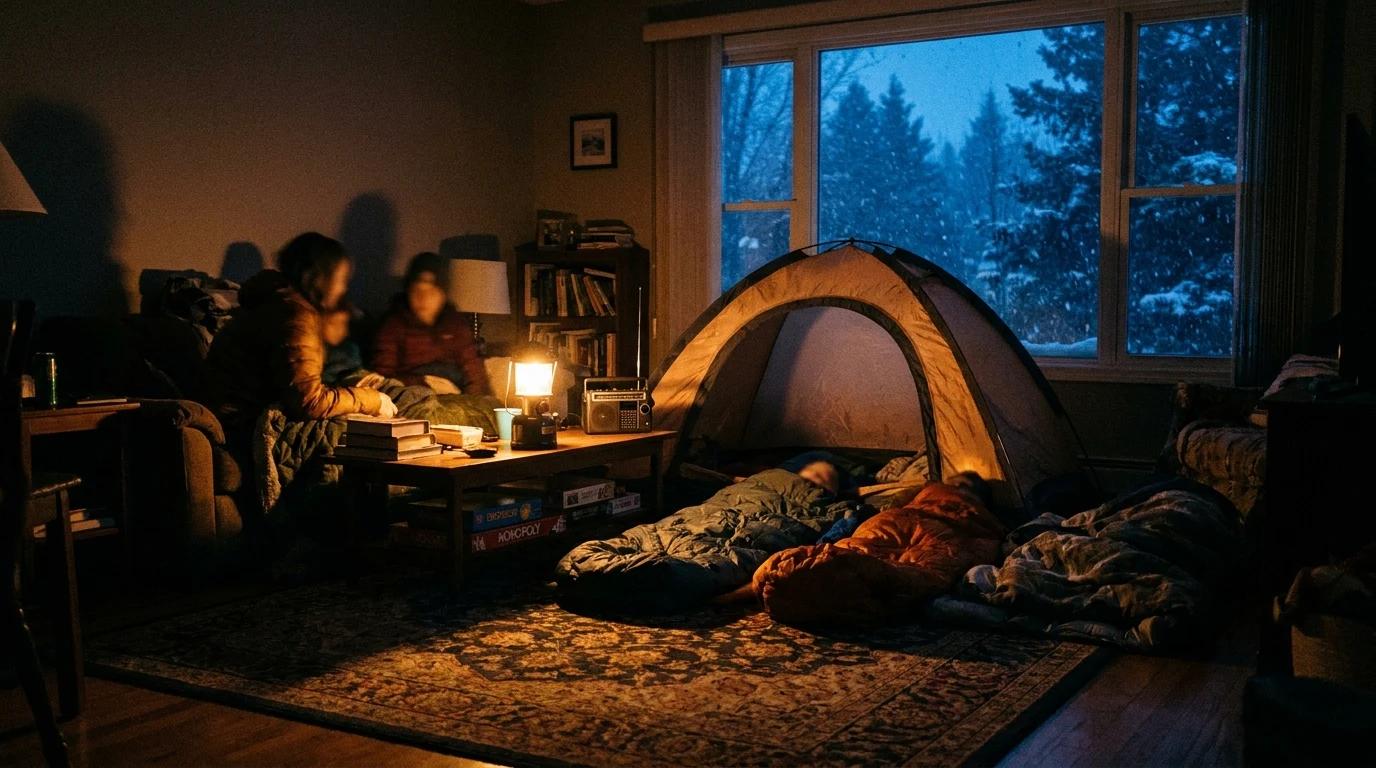
Consumer Reports suggests camping out inside your home: a tent and sleeping bags in one room keep bodies warm through the night. It also recommends loose layers rather than one heavy layer, and staying dry, since hypothermia is a particular concern for young children and older adults. Close off the rooms you are not using.
This costs nothing, produces no carbon monoxide, and for many outages is enough.
Keep the heat you have
Consumer Reports' next step is sealing leaks. Use caulk or weather stripping around windows and doors if you can, and draft guards on drafty doors. Towels and blankets work fine if that is what you have. Do this before you buy fuel, and keep any vent a heater's manual requires open: sealing a room and running an unvented heater in it are opposite goals, and the vent wins.
Add a carbon monoxide alarm first
Buy the alarm before the heater. CDC says to install battery-operated or battery back-up detectors near every sleeping area, and CPSC says every level of the home. The Kidde COB runs on two AA batteries, and the Kidde COBD10 has a 10-year built-in battery and a display. Early signs of CO poisoning resemble the flu, per Mr. Heater's manual: headache, dizziness, nausea. If you feel them, get to fresh air at once.
Rule of thumb: no alarm, no fuel-burning heater. They are one purchase.
If you add a fuel-burning heater
Consumer Reports only recommends a portable propane heater designed for indoor use in an emergency, and only if you can follow the safety instructions. These heaters produce carbon monoxide, so they need a vent.
The maker's rules are specific, and they differ by model:
| Heater | Output | Vent Mr. Heater requires |
|---|---|---|
| Little Buddy | 3,800 BTU | 4 sq in |
| Portable Buddy | 9,000 BTU | 9 sq in at ceiling and floor |
| Buddy FLEX | 11,000 BTU | 11 sq in at ceiling and floor |
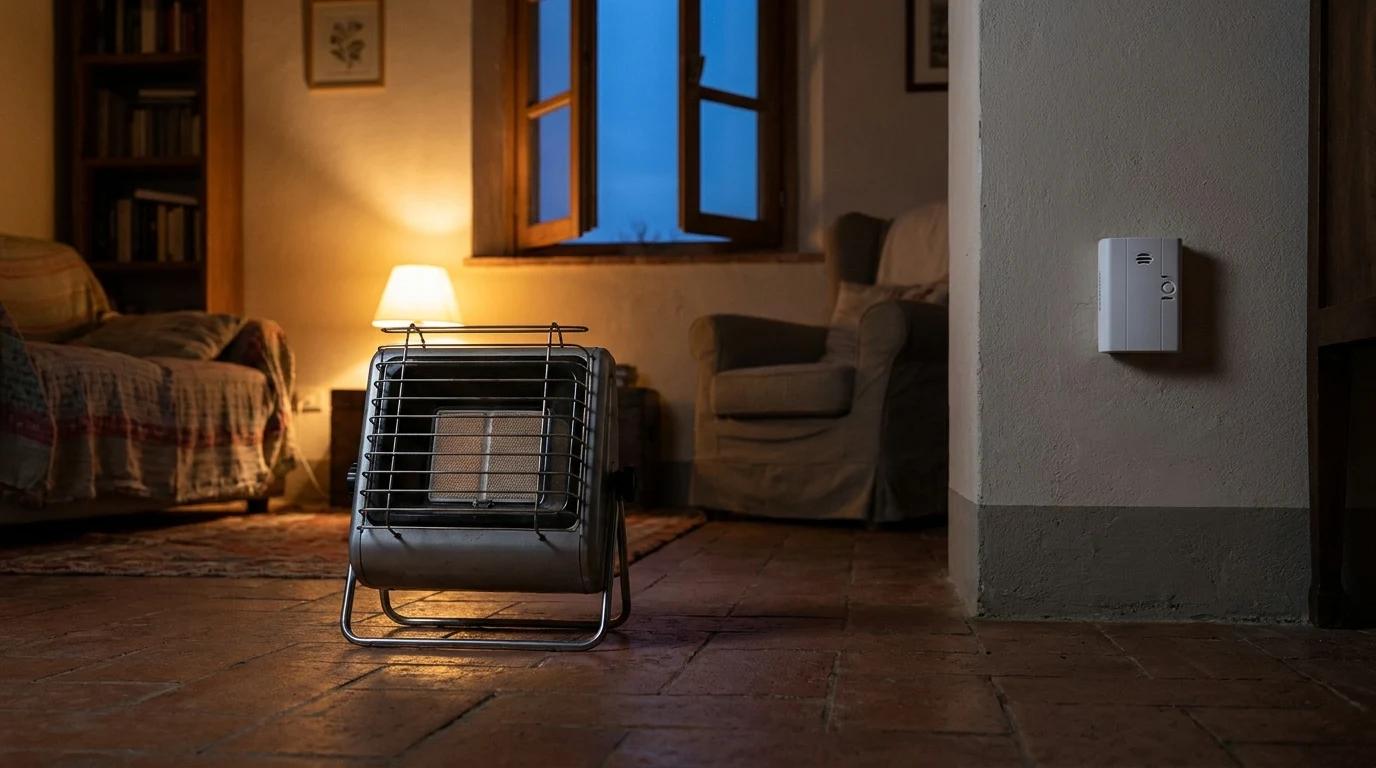
Those manuals allow emergency indoor heating only on a disposable 1 lb cylinder, say never to operate the heater while sleeping, and say to use no other fuel-burning appliance inside. They also state US sale except Massachusetts, and that the heaters are not for use in a dwelling home in California. CPSC adds: keep a window open at least one inch, keep doors open to the rest of the house, and do not use a heater too large for the room, because an oversized heater can deplete oxygen.
Fuel planning is simple division. Mr. Heater states these run times from a 1 lb cylinder:
| Heater | Hours per cylinder | Cylinders for 12 hours |
|---|---|---|
| Little Buddy | 5.6 | 3 |
| Portable Buddy on low | 6 | 2 |
| Portable Buddy on high | 3 | 4 |
| Buddy FLEX on low | 3.5 | 4 |
Store spares outdoors, as the manual says. Buy cylinders before the storm rather than counting on a store being open during one.
Why a battery will not run a space heater
A space heater draws up to 1,500 W, so the arithmetic is unkind. A 1,024 Wh power station such as the Anker Solix C1000 Gen 2 delivers about 870 Wh after inverter loss, which is about 35 minutes at 1,500 W. A 3,072 Wh Anker Solix F3000 lasts about an hour and three quarters.
A generator outdoors changes that sum. Consumer Reports notes that a small 1,800 to 2,000 W recreational generator can power a large space heater and charge phones, because fuel holds far more energy than a home battery. The same rules apply: outdoors, away from windows, with heavy-duty cords.
Batteries are better used on the things that make a cold room bearable: lights, a phone, a radio. The Runtime Calculator runs this for your own list.
Running your furnace on backup power
A gas or oil furnace still needs power for its blower, which Champion puts at 300 to 800 W for a 1/2 HP fan, so an outdoor generator with a proper connection can often keep it running. How to run a gas furnace in a power outage covers the options.
When to stop and leave
Leave if the room cannot stay safely warm, if anyone has symptoms, or if a medical need depends on power. Check with local officials about heating locations open near you. A warm room somewhere else beats a risky one at home.
Questions people ask
Can I heat my house with a gas oven in a power outage?
No. CDC says never to heat your house with a gas oven, and Ready.gov says the same about a gas stove or oven because it raises the risk of carbon monoxide poisoning and fire.
Is a propane heater safe indoors without power?
Only one the maker rates for it, used as the manual says. Mr. Heater's Buddy manuals allow emergency indoor heating on a 1 lb cylinder with a stated vent, and say never to run them while sleeping. They are not for a dwelling home in California.
Can a power station run a space heater?
Only briefly. At 1,500 W, a 1,024 Wh station lasts about 35 minutes after inverter loss.
What about a fireplace?
Use a well-maintained one if you have it, keep the area clear, and never go to bed with a fire burning. CPSC says to keep the damper open until the ashes are cool.
Sources for this guide
Outage Ready Editorial
We work out the arithmetic and read the maker and agency pages so you do not have to. About us.
Read next
What to Do When the Power Goes Out: First-Hour Checklist
A calm, ordered first hour: light, breaker, fridge door, surge protection, then a plan for food, heat and medical devices.
5 min read
Power Station vs Generator: Which One Fits Your Outage?
A power station suits short outages and indoor use; a generator suits long outages and heavy loads you can run 20 feet from the house.
5 min read