Guide
Carbon Monoxide Detector Beeping: Alarm, Battery or End of Life?
Outage Ready Editorial · Updated November 21, 2026 · 5 min read
Quick answer
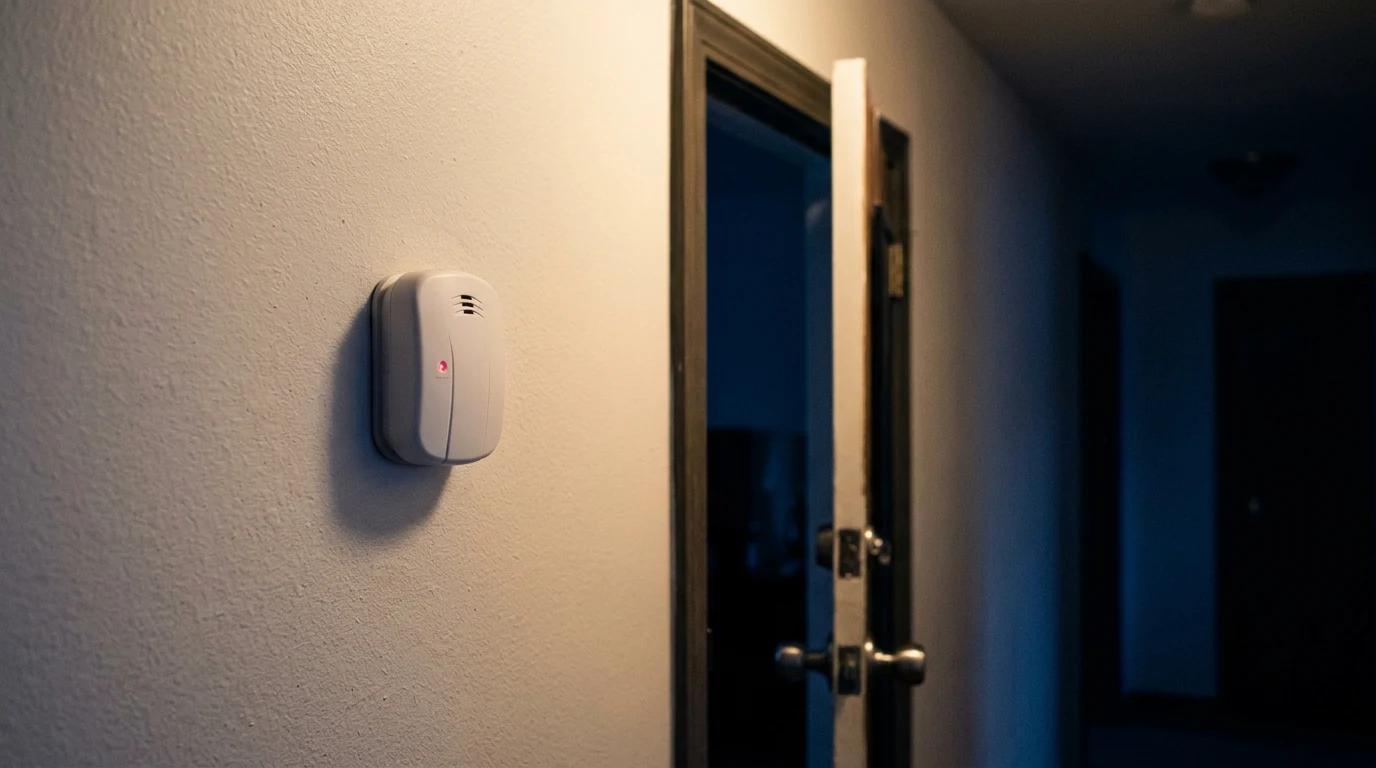
Four loud beeps, a pause, then repeating means carbon monoxide: get everyone outside and call 911. One chirp every 30 to 60 seconds is maintenance: usually a low battery, or the alarm reaching end of life, which a new battery will not fix.
Key takeaways
- Four loud beeps, a pause and a repeat means CO: get outside and call 911.
- One chirp a minute is a low battery on Kidde and First Alert alarms.
- Kidde's end of life is a chirp every 30 seconds; First Alert's is five beeps a minute.
- An alarm in end-of-life mode no longer detects CO, per Kidde: replace it the same day.
The short answer
If your carbon monoxide detector is sounding four loud beeps, pausing, and repeating, treat it as carbon monoxide: get everyone outside to fresh air and call 911 from there. A single short chirp every 30 to 60 seconds is a maintenance signal, usually a low battery or an alarm at the end of its life, and the exact meaning depends on the brand. When you are not sure which you are hearing, treat it as an emergency.
This post explains what each pattern means according to the makers. It is not medical advice: if anyone feels unwell, tell the 911 dispatcher.
What each beep means
| What you hear | Kidde | First Alert | What to do |
|---|---|---|---|
| 4 loud beeps, pause, repeat | CO alarm | CO alarm | Get outside, call 911 |
| 1 chirp every minute | Low battery | Low battery | Replace the batteries |
| 1 chirp every 30 seconds, red light flashing | End of life (non-digital models) | — | Replace the alarm |
| 5 beeps every minute | — | End of life | Replace the alarm |
| Long continuous squeal | Unplugged, loose, or malfunction | — | Reseat it, or call Kidde |
| "Lb" on the display | Low battery | — | Replace the batteries |
| Any number on the display | Assume CO is present | — | Leave and call 911 |
On a combination smoke and CO alarm, X-Sense notes that on many US models groups of three beeps mean smoke and groups of four mean carbon monoxide. Patterns differ between models, and every maker we read says to check the manual for your exact alarm.
The four-beep alarm: what to do
The alarm pattern is four short beeps, then about five seconds of silence, then four more, in Kidde's description. First Alert calls it an emergency: move to fresh air and call 9-1-1.
NFPA's steps:
- Move immediately to a fresh air location outdoors, or by an open window or door.
- Make sure everyone inside is accounted for.
- Call for help from the fresh air location.
- Stay there until emergency personnel say it is safe to go back in.
Do not stay inside to find the source, and do not silence the alarm and go back to bed. CDC lists the most common symptoms of CO poisoning as headache, dizziness, weakness, upset stomach, vomiting, chest pain and confusion, and warns that people who are asleep can die before they have symptoms.
If in doubt: outside first, then the phone call. A false alarm costs a few minutes; the other kind does not.
Before you ever hear it
NFPA suggests two things to do now, while nothing is beeping. Call your local fire department's non-emergency number and ask what number to call if the CO alarm sounds, and test each CO alarm at least once a month.
If your alarm has a display, learn what it shows. Kidde says that any time a digital unit displays a number, with or without an alert, you should assume it senses carbon monoxide, leave the home and call 911. Kidde also describes nuisance alarms, but never decide that an alarm is a false one from inside the house: let the fire department make that call after everyone is outside.
The single chirp: low battery or end of life?
A chirp on its own is not a CO alarm. Work through it in this order:
- Replace the batteries. Kidde and First Alert both say a chirp once a minute means the batteries are low.
- On sealed 10-year alarms such as the Kidde COBD10 or First Alert CO710, there is no battery to change: a low-battery or end-of-life chirp means replace the whole alarm.
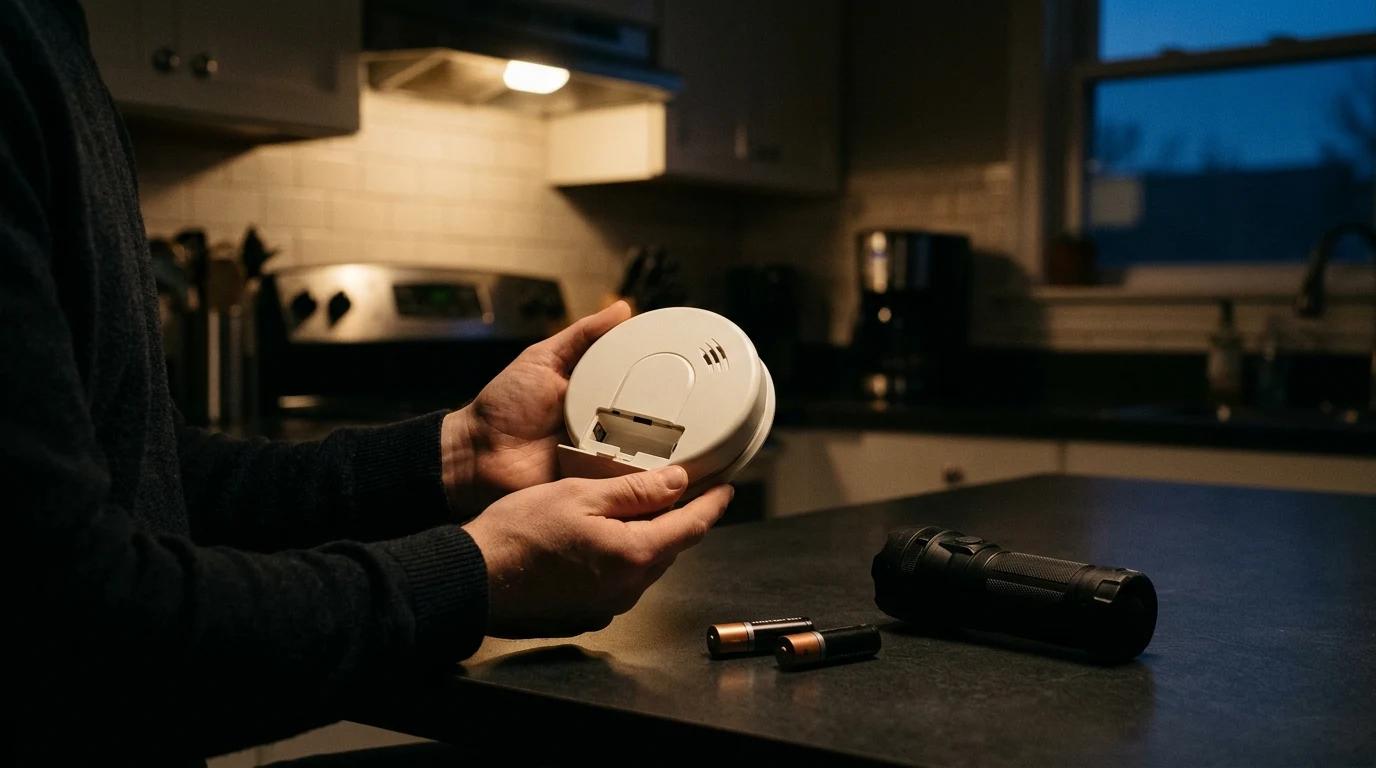
- If it still chirps, look at the age. Kidde says its alarms chirp every 30 seconds at the end of their 7- or 10-year life, and that the chirp will not stop until the unit is powered off. First Alert's end-of-life signal is five beeps every minute. A new battery will not silence either.
- If you still cannot tell, NFPA says that if the trouble signal keeps sounding after you replace a low battery, call the fire department.
End of life means it is no longer protecting you
Kidde says plainly that a CO alarm in end-of-life mode can no longer detect carbon monoxide. Replace it the same day. CDC says to replace your CO detector following the manufacturer's instructions or every 5 years, and NFPA says to replace alarms according to the maker's instructions. The date is printed on the back of most alarms; write the replacement year on it with a marker when you install a new one.
End-of-life chirp: a new alarm, not a new battery.
Why outages make this matter more
An outage is when people bring out the things that make carbon monoxide: generators, propane heaters, camp stoves. It is also when a plug-in alarm with no battery stops working. CPSC says to install battery-operated CO alarms, or alarms with battery backup, on every level of the home and outside sleeping areas, and that interconnected alarms are best.
If you are replacing an alarm anyway, choose one that does not depend on wall power:
- Kidde COB: two AA batteries, the low-cost way to cover several rooms
- Kidde COBD10: a 10-year built-in battery and a display that shows a CO reading
- First Alert CO710: a sealed 10-year cell with a peak-level memory
Each one is compared in our CO alarm comparison.
A note on generators and heaters
If the alarm sounds while a generator is running, the generator is the first suspect. CDC says never to use a generator inside your home or garage, even with doors and windows open, and to run it outdoors more than 20 feet from windows, doors and vents. Fuel heaters need their maker's ventilation rules; see how to heat your home without power.
What to do right now
- Four loud beeps, repeating
- Get out, call 911
- That is the CO alarm pattern for Kidde and First Alert.
- One chirp a minute
- New batteries
- Both makers call it low battery; on a sealed 10-year alarm, replace the alarm.
- Still chirping with new batteries
- New alarm
- End of life; Kidde says it can no longer detect CO.
- Cannot tell which pattern
- Treat it as an alarm
- Go outside, then call the fire department.
Questions people ask
Why is my carbon monoxide detector beeping 4 times?
Four short beeps, a pause, then four more is the CO alarm pattern for Kidde and First Alert. Get everyone to fresh air outside and call 911 from there.
Why is my CO detector chirping after I changed the battery?
It has probably reached end of life. Kidde says its end-of-life chirp comes every 30 seconds and does not stop with new batteries; First Alert's is five beeps a minute. Replace the alarm.
How long do carbon monoxide detectors last?
Kidde says its alarms last 7 or 10 years depending on the model. CDC says to replace a detector following the manufacturer's instructions or every 5 years.
Can I just take the battery out to stop the chirping?
Only if you replace the alarm right away. An alarm with no battery, or in end-of-life mode, cannot detect carbon monoxide.
Sources for this guide
- Kidde: Why is my carbon monoxide alarm beeping or chirping?
- Kidde: Carbon monoxide detector replacement FAQs
- First Alert: Why is my carbon monoxide detector beeping?
- X-Sense: Carbon monoxide detector beeping, what it means
- NFPA: Carbon monoxide safety tip sheet
- CDC: Carbon monoxide poisoning basics
- CPSC: Carbon monoxide information center
Outage Ready Editorial
We work out the arithmetic and read the maker and agency pages so you do not have to. About us.
Read next
What to Do When the Power Goes Out: First-Hour Checklist
A calm, ordered first hour: light, breaker, fridge door, surge protection, then a plan for food, heat and medical devices.
5 min read
How to Heat Your Home Without Power, Safely
Heat one small room, with a wood stove or an indoor-rated heater if you have one, and never with an oven, a camp stove or a generator inside.
5 min read