Guide
FRS vs GMRS: Which Radios Need a License?
Outage Ready Editorial · Updated November 21, 2026 · 5 min read
Quick answer
FRS radios need no license and are limited to 2 watts; GMRS radios need an FCC license, a $35 application good for 10 years that covers your immediate family, in exchange for more power and repeaters. For a household outage plan, license-free FRS radios are usually enough.
#1 · Most households
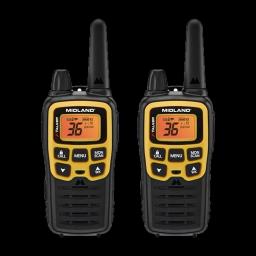
Midland T61VP3 X-Talker FRS Walkie-Talkie 2-Pack
4.4 (1,597)License-free FRS with NOAA weather alerts; Midland states it also runs on three AAA cells.
$79.99Buy on Amazon
#2 · A radio that doubles as a light
Motorola Talkabout T475 Extreme 2-Pack
4.3 (887)FRS with NOAA alerts, a built-in flashlight and dual power.
$79.99Buy on Amazon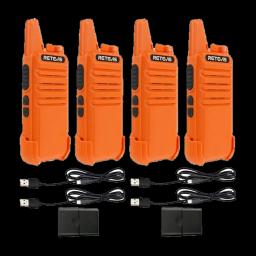
#3 · Four people on a budget
Retevis RT22 Rechargeable FRS Walkie-Talkie 4-Pack
4.5 (4,755)Four slim FRS radios with USB-C charging and hands-free VOX.
$47.99Buy on Amazon
| Pick | Best for | Ready | Buy |
|---|---|---|---|
 1. Midland T61VP3 X-Talker FRS Walkie-Talkie 2-Pack 4.4 (1,597) | Most households License-free FRS with NOAA weather alerts; Midland states it also runs on three AAA cells. | 71 | $79.99Buy on Amazon |
 2. Motorola Talkabout T475 Extreme 2-Pack 4.3 (887) | A radio that doubles as a light FRS with NOAA alerts, a built-in flashlight and dual power. | 69 | $79.99Buy on Amazon |
 3. Retevis RT22 Rechargeable FRS Walkie-Talkie 4-Pack 4.5 (4,755) | Four people on a budget Four slim FRS radios with USB-C charging and hands-free VOX. | 61 | $47.99Buy on Amazon |
Key takeaways
- FRS needs no license; GMRS requires an individual FCC license.
- The GMRS license fee is $35 for a 10-year term, covering immediate family, per the FCC.
- FRS handhelds are capped at 2 W on channels 1–7 and 15–22 and 0.5 W on 8–14.
- GMRS mobile and base stations may use up to 50 W and repeaters.
- Box range figures are best cases; Midland says range is never exact.
The short answer
FRS radios need no license and are limited to 2 watts on most channels; GMRS radios need an FCC license, with a $35 application fee and a 10-year term, and they are allowed far more power and repeaters. Both use the same 22 shared channels, so they can talk to each other. For a household that wants to stay in touch across a street or a neighborhood during an outage, license-free FRS radios are enough. GMRS is worth the license when you need more range through a repeater or a base station antenna.
| FRS | GMRS | |
|---|---|---|
| License | None; licensed by rule | Individual FCC license required |
| Fee and term | None | $35 application fee, 10-year term |
| Who may talk on it | Anyone | The licensee and immediate family |
| Handheld power | 2 W on channels 1–7 and 15–22, 0.5 W on 8–14 | Up to 5 W on the 462 MHz interstitials; handhelds limited by battery and RF rules in practice |
| Mobile and base power | Not allowed | Up to 50 W on the main channels |
| Antenna | Fixed, built in | Fixed on handhelds; Midland suggests an outside antenna for vehicle radios |
| Repeaters | No | Yes |
| Station ID | None | Call sign at the end, and every 15 minutes |
What FRS gives you without a license
The FCC describes FRS as a short-distance, two-way service for family and group activities, licensed by rule so the public can use the radios without a license. Under Part 95, FRS has 22 channels, all shared with GMRS. The power caps are fixed in the radio's design: 2 watts on channels 1 to 7 and 15 to 22, and half a watt on channels 8 to 14. The antenna must be a non-removable part of the radio.
Since September 30, 2019, the FCC has barred selling handheld radios that combine FRS with any other licensed or licensed-by-rule service, so a new radio is certified as one or the other, and the box says which.
That is the whole appeal for an outage plan. Anyone in the house, of any age, can pick one up and talk, with nothing to file and no call sign. The rules also allow one-way emergency messages on FRS.
What a GMRS license adds
GMRS is the licensed big brother on the same frequencies. The FCC's rules require a valid individual license to operate a GMRS station. You must be at least 18 to apply, and one license covers your immediate family: Part 95 lists spouse, children, grandchildren, stepchildren, parents, grandparents, stepparents, brothers, sisters, aunts, uncles, nieces, nephews and in-laws. The FCC's fee schedule lists the application at $35 with no regulatory fee, and the license term is 10 years.
In return you get:
- More power. Mobile and base stations may run up to 50 watts on the main channels. Handhelds are capped at 5 watts on the 462 MHz interstitial channels, and Midland notes that a handheld's power is limited in practice by battery life and RF exposure rules.
- Repeaters. A repeater on a hill or tower relays your signal, and Midland explains that radios in reach of it can talk even when they are out of range of each other.
- Antenna placement. Midland recommends an antenna outside the vehicle, because the vehicle itself blocks the signal, and line of sight matters more than raw watts.
The obligations are small but real: you must say your call sign at the end of a transmission and at least every 15 minutes during a long one. The rules also let a licensee allow anyone to use their station to send an emergency message.
The box tells you: if a radio is sold as GMRS, transmitting with it needs a license, even on the channels it shares with FRS.
How far will they actually reach?
Not as far as the packaging says. Midland, which prints up to 36 and 38 miles on its radio boxes, says itself that two-way radio range isn't exact and isn't the same every time you use the same radio. Its explanation is line of sight: the earth's curvature and anything in the way, such as vehicles, trees, buildings and hills, cut range, and weather can raise or lower it. Treat any mileage on the box as a best case between two high points with nothing in between.
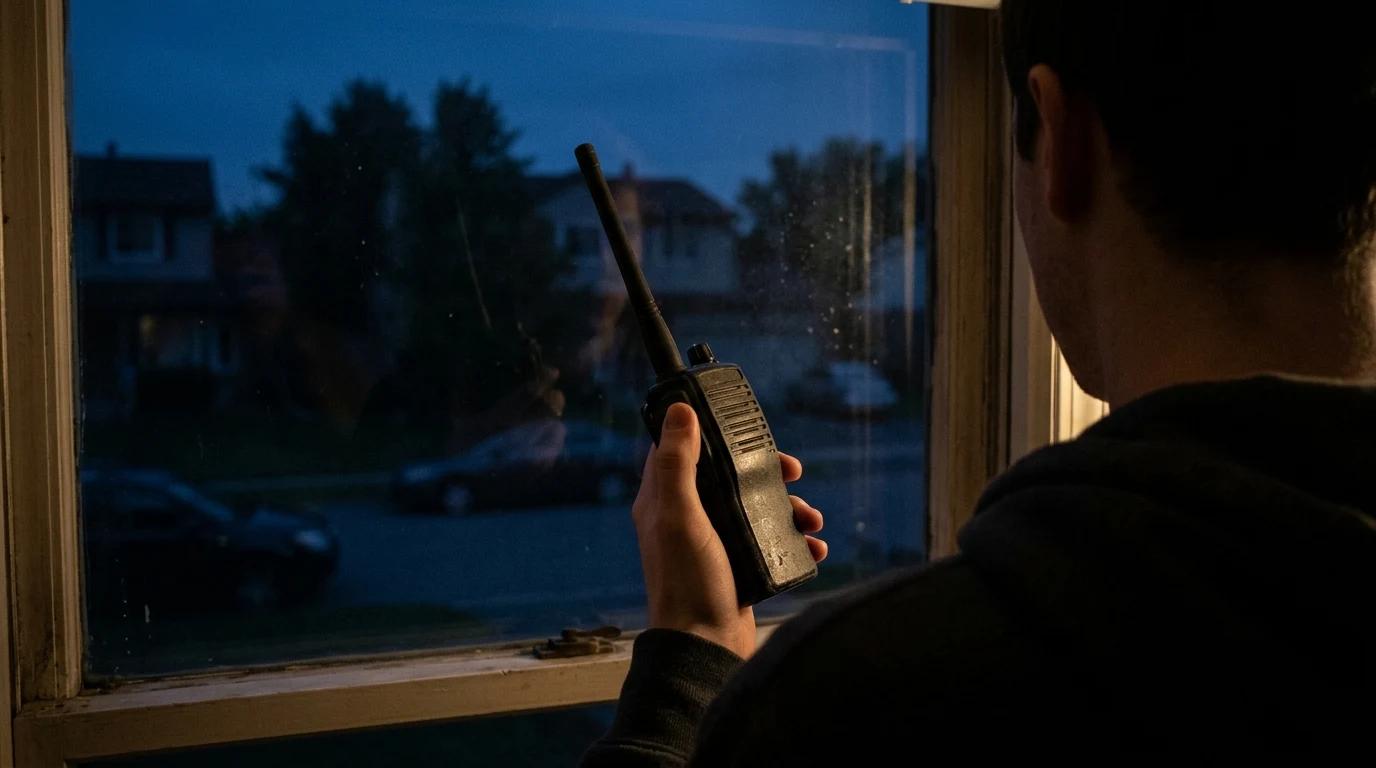
For planning, the honest method is to test. Walk or drive your neighborhood with a partner on the same channel and note where the signal drops. Indoors, near a window and higher up usually helps, which matches Midland's line-of-sight point. If the place you need to reach, a relative's house across town, fails the test, that is the case for GMRS and a repeater, not for a more expensive FRS radio.
Which to choose for an outage plan
- Family in one house or one street: FRS. No license, everyone can use it, and the 22 channels are enough.
- Two households a few miles apart: start with FRS and test the route. If it fails, a GMRS license with a base station antenna or a local repeater is the realistic upgrade.
- Teen drivers or relatives across town: GMRS, because only a repeater or a high base antenna covers that distance reliably.
- You want weather warnings too: many FRS radios include NOAA weather channels, and the walkie-talkie picks mark which ones do. For an alarm that wakes you at night, a dedicated alert radio such as the Midland WR400 sits by the bed.
Plan it once: agree on a main channel, a backup channel and a check-in time, and write them on the fridge with the batteries.
Make the radios outage-proof
- Keep spare batteries, or choose radios that also take AA or AAA cells, so a dead pack is not the end of the plan.
- Charge them when a storm is forecast, alongside phones and power banks.
- Turn on any keypad lock so a radio in a pocket does not change channel.
- Practise once with the whole household, so the youngest knows how to press and hold to talk and release to listen.
Questions people ask
Do I need a license for FRS radios?
No. The FCC licenses FRS by rule, so anyone can use FRS radios without applying for a license.
How much is a GMRS license?
The FCC's fee schedule lists a $35 application fee and no regulatory fee. The license lasts 10 years and covers your immediate family.
Can FRS and GMRS radios talk to each other?
Yes. All 22 FRS channels are shared with GMRS, so the two can talk on those channels.
How far can walkie-talkies reach?
Far less than the box usually says. Midland says range is never exact and depends on line of sight, obstructions, terrain and weather. Test your own route.
Which is better for emergencies, FRS or GMRS?
FRS for a household on one street, since anyone can use it without a license. GMRS when you need miles of range through a repeater or a base station antenna.
Sources for this guide
Outage Ready Editorial
We work out the arithmetic and read the maker and agency pages so you do not have to. About us.
Read next
What to Do When the Power Goes Out: First-Hour Checklist
A calm, ordered first hour: light, breaker, fridge door, surge protection, then a plan for food, heat and medical devices.
5 min read
Power Outage Kit Checklist: Starter, Household, Full
Three build-your-own outage kits, with every item listed and the totals worked out.
5 min read