Guide
How to Cook Without Power, Safely
Outage Ready Editorial · Updated November 21, 2026 · 5 min read
Quick answer
Cook outdoors on a camp stove or grill, light your gas cooktop's burners with a match if you have one, or run a microwave or induction burner from a power station indoors. Never use a camp stove or charcoal indoors, and never use a gas stove or oven to heat the house.
Key takeaways
- Camp stoves and charcoal grills are outdoor-only; CDC says never use them indoors.
- A gas cooktop's burners can be lit with a match in an outage, per GE Appliances; the oven cannot.
- Never use a gas stove or oven to heat the house, Ready.gov says.
- An induction burner draws 1,200 to 1,800 W, so a 1,024 Wh station gives about 29 minutes at full power.
- Canned food can be eaten cold, straight from the can.
The short answer
To cook without power, take a camp stove or grill outside, light a gas cooktop's burners with a match if you have one, or run a microwave or induction burner from a power station indoors. The one rule that does not bend: anything that burns fuel and is not part of your kitchen's own gas range stays outdoors. CDC says never to use a portable gas camp stove indoors and never to burn charcoal indoors, and Ready.gov says charcoal grills and camp stoves are for outdoor use only.
| Method | Where | What the source says |
|---|---|---|
| Camp stove, butane or propane | Outdoors only | CDC: never use a portable gas camp stove indoors |
| Charcoal or gas grill | Outdoors, away from the house | CDC: never burn charcoal indoors; NFPA: keep the grill well away from the home |
| Gas cooktop, lit with a match | Indoors, burners only | GE Appliances: the surface burners can be lit by hand; the oven cannot |
| Induction burner or microwave on a power station | Indoors | No combustion, so no carbon monoxide |
| Canned food, unheated | Anywhere | Ready.gov: commercially canned food can be eaten from the can |
Option 1: a camp stove, outside
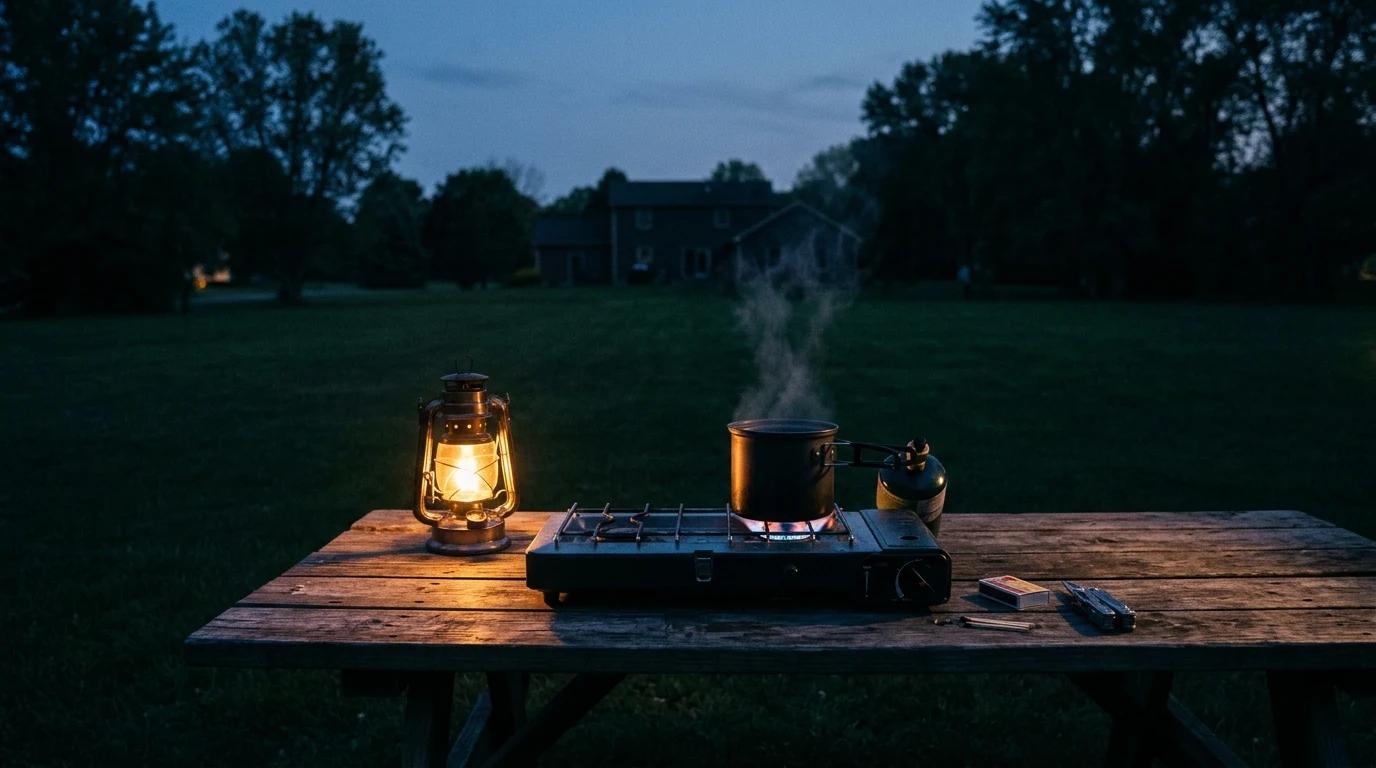
A camp stove is the cheapest dependable way to boil water and heat food, and the right one depends on how many you feed. The camp stove picks compare them, and every one goes outdoors: Ready.gov adds the 20-foot rule from windows for camp stoves and grills, the same as for generators.
- One or two people: a single butane burner such as the Coleman Classic 1-Burner heats a pot at a time.
- Serious cooking on one burner: the Iwatani 35FW is rated at 15,000 BTU. Iwatani states a canister lasts about 55 minutes at full power, so a 4-pack is roughly three and a half hours of full flame.
- A family: two burners matter, and the Camp Chef Everest 2X gives two 20,000 BTU burners on propane.
Mind the weather. Iwatani's manual says the 35FW is not for use below freezing, and butane generally struggles in the cold, so a winter outage favors propane. On the indoor question, Iwatani says its butane stoves are approved for indoor use in commercial restaurants, and its manual carries a carbon monoxide warning. A home kitchen is not a restaurant with commercial ventilation, so treat any camp stove, butane included, as outdoor gear.
Outdoor rule: stove or grill outside, at least 20 feet from windows, with a battery CO alarm inside the house anyway.
Option 2: the gas cooktop you already have
If you cook on gas, the burners may still work. GE Appliances explains that during an outage gas still reaches the burner but the electric igniter cannot spark, so you can hold a lit match next to a burner and turn the knob to low. GE's warning matters: if the flame blows out, gas keeps flowing, so make sure it stays lit or turn the knob off. The oven is a different story. GE says the oven's ignition and gas valve need power, so it cannot be lit by hand.
Cook only. Your range hood will not run in an outage, so crack a window while a burner is on, and keep the battery CO alarm nearby. Ready.gov says not to use a gas stove or oven to heat your home, because it raises the risk of carbon monoxide poisoning, fires and burns. A burner that warms a pot for 15 minutes is cooking; one left on for an hour to warm the room is the mistake.
Option 3: electric cooking on a power station
A power station has no exhaust, which makes it the only indoor heat source here with no carbon monoxide at all. The catch is wattage. Champion's wattage chart puts a portable induction cooktop at 1,200 to 1,800 W and a microwave at 600 to 1,200 W, so the station's output must cover the appliance.
| Appliance | Watts, per Champion | 10 minutes costs about |
|---|---|---|
| Microwave | 600–1,200 W | Up to 240 Wh after inverter loss |
| Induction burner | 1,200–1,800 W | Up to 350 Wh after inverter loss |
The Anker Solix C1000 Gen 2 is rated at 2,000 W, enough for an 1,800 W burner, and its 1,024 Wh gives about 870 Wh after our 0.85 inverter factor. That is about 29 minutes of induction at full power, or a few days of short microwave reheats. Cooking eats stored energy fast, so if the station also keeps a fridge cold, cook on the stove outdoors and save the battery for the food. The Runtime Calculator shows how your own loads add up.
Option 4: food that needs no cooking
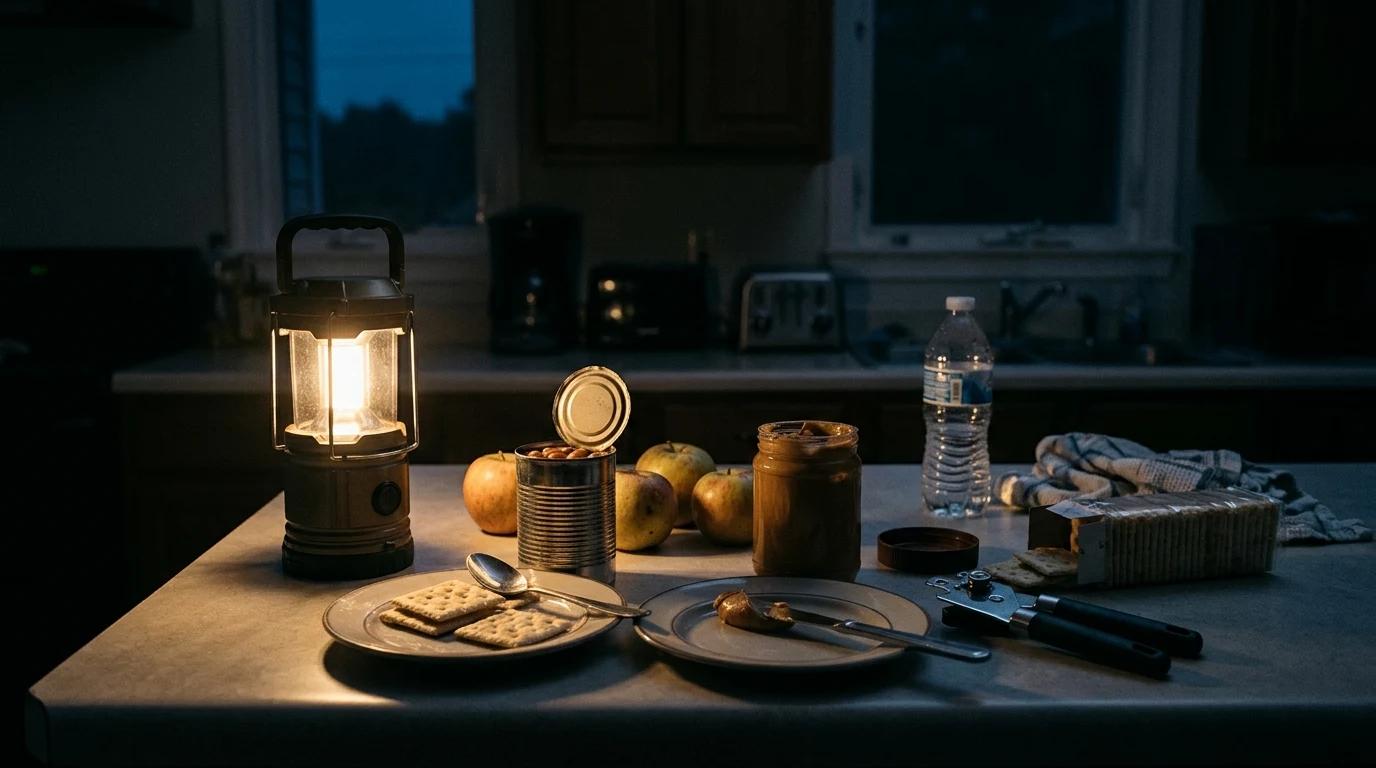
Ready.gov's advice is to stock canned foods, dry mixes and staples that need no refrigeration, cooking, water or special preparation, along with a manual can opener. Commercially canned food can be eaten straight from the can. If you want it warm, Ready.gov says to remove the label, wash and disinfect the can (with a 1:10 bleach solution) and open it before heating it. Our non-perishable food list builds a few days of these meals by household size.
Plan fuel by the meal
Fuel runs out before food does. Iwatani's figure of about 55 minutes per canister at full flame is a useful yardstick for any butane stove: most outage meals are reheats and boiled water that take minutes, not an hour, so turn the flame down once a pot boils and keep a lid on it. Count your canisters or propane cylinders before a storm, not during it.
Coffee and boiled water
For coffee, boil water on the camp stove outside or on a match-lit gas burner, then use a pour-over cone or a French press, which need no power. Boiling also treats water: Ready.gov calls boiling the safest method and says to hold a rolling boil for one full minute.
Two mistakes that hurt people
- Grilling in the garage or under the eaves. CDC is explicit that charcoal gives off carbon monoxide, and NFPA says to keep a grill well away from the home, deck railings and overhanging branches. An open garage door is not enough ventilation.
- Leaving a burner unattended. NFPA says never to leave a grill unattended, and the same habit applies to a camp stove. Turn the fuel off at the stove when you are done.
If anything in your house burns fuel during an outage, a battery CO alarm is the cheapest safeguard you can buy. The Kidde COB runs on two AA batteries, and the CO alarm picks cover the rest.
Questions people ask
Can you use a gas stove during a power outage?
Often the burners, yes. GE Appliances says you can light an electric-ignition burner with a match and turn it to low. The oven needs power and cannot be lit by hand. Use it for cooking only, never to heat the house.
Can I use a butane camp stove indoors?
CDC says never to use a portable gas camp stove indoors. Iwatani's indoor approval covers commercial restaurants, not homes, so keep it outside.
Can a power station run an induction cooktop?
Yes, if its output covers the burner. Champion puts portable induction cooktops at 1,200 to 1,800 W, so a station rated at 2,000 W can run one at full power for about half an hour per 1,000 Wh.
How do you make coffee without power?
Boil water on a camp stove outdoors or a match-lit gas burner, then brew with a pour-over cone or a French press.
Sources for this guide
- CDC: Carbon monoxide poisoning basics
- Ready.gov: Power outages
- Ready.gov: Food
- Ready.gov: Water
- NFPA: Grilling safety
- GE Appliances: Lighting electric ignition burners during a power failure
- Iwatani: 35FW instruction manual (English)
- Iwatani: FAQ on indoor approval
- Champion Power Equipment: Generator wattage chart
Outage Ready Editorial
We work out the arithmetic and read the maker and agency pages so you do not have to. About us.
Read next
Non-Perishable Food for a Power Outage: A No-Cook List
A no-cook shopping list for three days, sized for one person or a family of four, with water and can safety.
5 min read
What to Do When the Power Goes Out: First-Hour Checklist
A calm, ordered first hour: light, breaker, fridge door, surge protection, then a plan for food, heat and medical devices.
5 min read