Guide
How to Open a Garage Door Without Power
Outage Ready Editorial · Updated November 21, 2026 · 6 min read
Quick answer
Make sure the garage door is fully closed, pull the red emergency release cord on the opener's trolley straight down, then lift the door by hand from the bottom section. Do not release a door that is open, and stop if the door is hard to lift, which points to a spring problem.
Key takeaways
- Close the door fully, then pull the red emergency release cord straight down.
- Never release a door that is open; weak springs can let it fall without warning, Chamberlain warns.
- A door that is hard to lift has a spring problem. Stop and call a professional.
- California has required battery backup on new residential openers since July 1, 2019.
- A backup battery gives about 24 hours of standby and up to 20 cycles, per Chamberlain.
The short answer
To open a garage door without power, make sure the door is fully closed, pull the red emergency release cord that hangs from the opener's trolley, then lift the door by hand. Chamberlain, which makes LiftMaster openers, puts the key warning first: use the release only when the door is fully closed, if possible, because weak or broken springs can let an open door fall rapidly and without warning.
| Step | What to do | Why |
|---|---|---|
| 1 | Close the door if it is not already down | The release is safest with the door closed, per Chamberlain and Genie |
| 2 | Clear people, pets and cars from the opening | A door with a bad spring can drop |
| 3 | Pull the red cord straight down | It disconnects the door from the opener |
| 4 | Lift with both hands from the bottom section | A balanced door should lift smoothly |
| 5 | Lower it gently and lock it | A released door has no opener holding it shut |
| 6 | Reconnect once power returns | Most openers re-latch on the next cycle |
Step by step, from inside
Check the hardware first. Genie's instructions start by looking at the springs and the door for damage. If a spring is snapped, cables hang loose, or rollers are out of their tracks, do not release the door. Chamberlain lists the stop signs plainly: a door that feels extremely heavy, falls quickly when released, or will not stay open needs a professional.
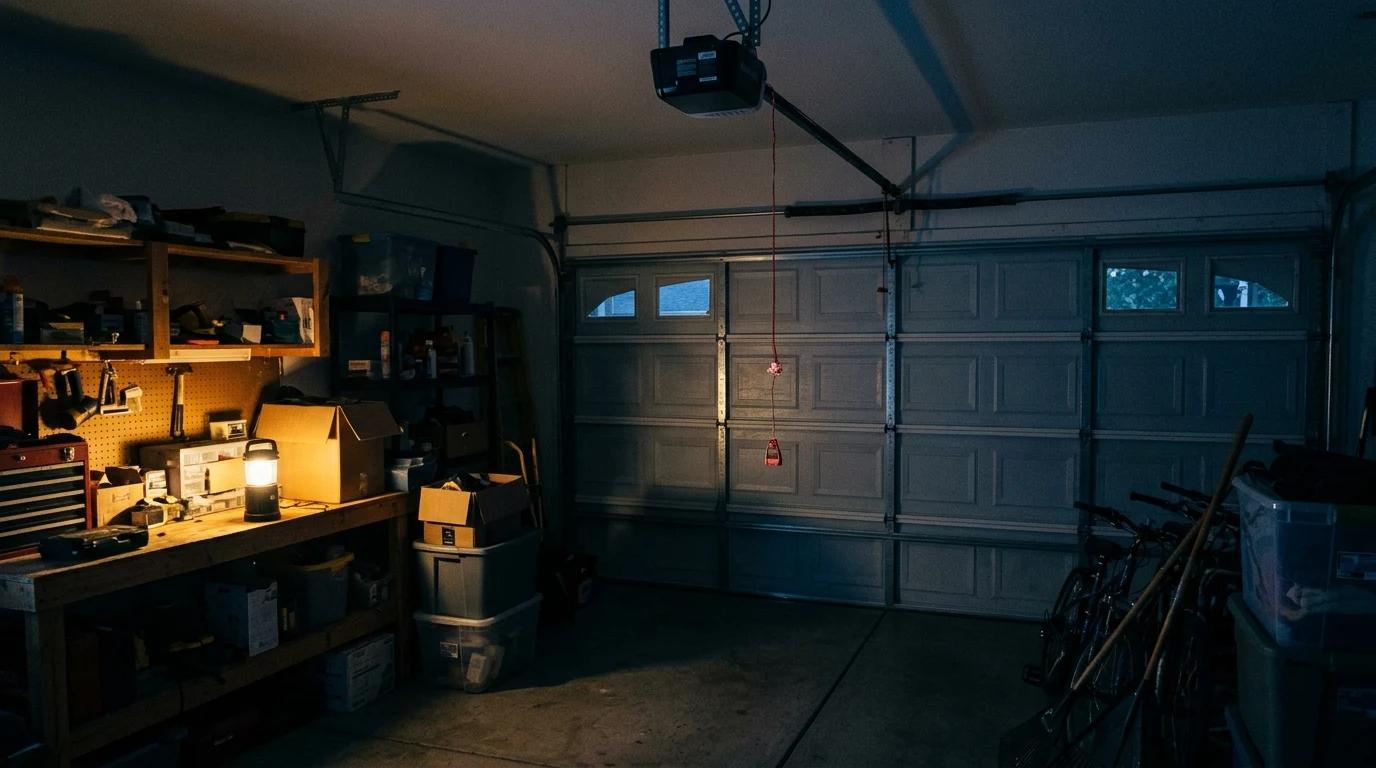
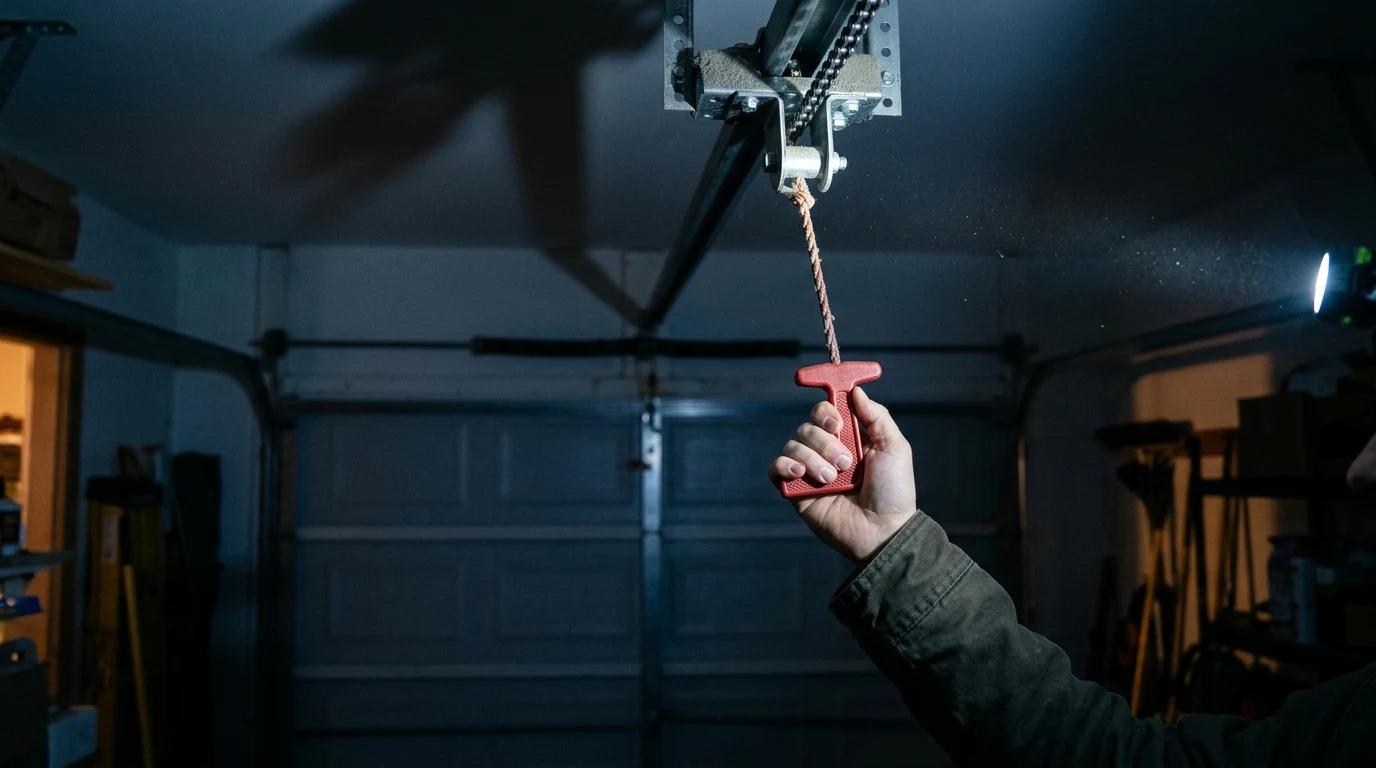
Pull the release. On most ceiling openers the red handle hangs from the trolley, near the door when it is closed. Chamberlain says to pull it down: on a square-rail opener the release arm snaps upright and the trolley lets go. On a T-rail opener, pulling straight down then back toward the motor locks the trolley out, so you can open and close the door by hand repeatedly without it re-latching. Wall-mounted openers beside the door use a handle you pull down firmly until it clicks, and Chamberlain says to unlock any manual door lock first.
Lift. Grip the bottom section, not the joints between panels, and keep fingers clear of hinges. Chamberlain's tip is worth remembering: a balanced door lifts smoothly, so a door that is hard to lift points to a spring problem. Stop rather than force it. Genie adds that if a door is too heavy for you, do not open it manually.
Safety first: never use the red handle to pull the door up or down, and never release a door that is standing open. Both warnings come straight from Chamberlain.
From outside, with no other way in
If the garage has no side door, you need an exterior emergency release kit: a small keyed lock near the top of the door that pulls a cable to the trolley. Chamberlain is blunt that without one, and with no other way into the garage, manual operation from outside is not possible during an outage. Genie's method is the same in reverse: turn the key, pull the lock tumbler, lift the door, then re-engage once you are inside. If you have neither a side door nor a release kit, add one of them to your outage plan before storm season.
Never idle a car in an attached garage while you sort this out. CDC says never to run a car or truck inside a garage attached to a house, even with the garage door open.
Locking it, and reconnecting
A released door is held shut only by its weight. If the door has a slide lock or a T-handle lock, use it while the opener is disconnected, and unlock it before you run the opener again. Genie also says to unplug the opener before working on the motor or trolley, in case the power returns while your hands are near the carriage.
When the power is back:
- Square rail: pull the cord toward the opener, then run the opener; Chamberlain says the trolley reconnects during a full open and close cycle.
- T-rail: pull the cord straight down, then run the opener; it reconnects on the next cycle.
- Genie: push the release lever up with a broom handle, or pull the cord up and toward the motor until it clicks. If the opener still will not run, Genie suggests unplugging it for up to 30 seconds to reset it.
Battery backup openers
California's SB 969 made battery backup standard there. Since July 1, 2019, no residential garage door opener may be sold or installed in California without a battery backup function designed to work during an outage, and a replacement garage door may not be connected to an old opener without one. Chamberlain says the law followed the 2017 wildfires, when some people could not lift their doors by hand.
The battery is a short-term bridge, not a week of service. Chamberlain states a fully charged backup battery gives about 24 hours of standby during which the opener can run up to 20 full cycles at room temperature. The battery itself is an accessory with a one-year warranty, per Chamberlain. A solid orange battery light with a beep every 2 seconds means the opener is on battery; a beep every 30 seconds means the battery is low.
Worth checking now: if your opener has a battery, look for its status light. A dead battery gives no backup at all.
Can a power station run a garage door opener?
Yes, and easily. Openers draw little and run for seconds. LiftMaster lists its 98022 wall-mount opener at 120 V and 2.7 amps, which is at most about 324 W while the motor runs. Even counting a full minute of motor time per opening, that is about 5 Wh, so energy is not the question; plugging in is. Run an extension cord from the station to the opener's outlet, open the door, then unplug.
Any station with a few hundred watts of output covers it. The Bluetti Elite 30 V2 is rated at 600 W with 288 Wh, and the Anker Solix C1000 Gen 2 at 2,000 W with 1,024 Wh, which also runs a fridge for about 10 hours on our 0.85 inverter factor. Check your own opener's label for its amps before you rely on this, since older and heavier-duty models differ. The Runtime Calculator does the arithmetic for the rest of the house.
Practise once, in daylight
The worst time to find the red handle is in the dark with the car running in the rain. Try the release once on a calm day with the door closed, so you know how heavy the door feels and how your model re-latches. If the door does not lift smoothly, book a spring check now rather than discovering it during an outage. Then keep a light by the garage door: our first-hour checklist starts with exactly that.
Questions people ask
How do you open a garage door when the power is out?
Close the door fully if you can, pull the red emergency release cord on the opener trolley straight down, and lift the door by hand from the bottom section.
How do you open a garage door from outside without power?
Only with an exterior emergency release kit, a keyed lock near the top of the door. Chamberlain says that without one, and with no other way into the garage, it is not possible.
How do I reconnect my garage door opener after a power outage?
On most Chamberlain and LiftMaster openers, reset the release and run the opener through a full cycle; the trolley re-latches. Genie says to push the release lever up or pull the cord toward the motor until it clicks.
How long does a garage door opener battery backup last?
Chamberlain states about 24 hours of standby with up to 20 full cycles on a fully charged battery. The backup battery is an accessory with a one-year warranty.
Can I run my garage door opener off a power station?
Yes. LiftMaster lists one wall-mount opener at 2.7 amps at 120 V, about 324 W at most, so almost any power station can run it for the few seconds it needs.
Sources for this guide
- Chamberlain Group: How to manually open or close a garage door
- Genie: The power is out, how to open your garage door manually
- California Legislature: SB 969, automatic garage door openers, backup batteries
- Chamberlain Group: California SB 969 FAQs
- Chamberlain Group: Why is the garage door opener beeping (backup battery figures)
- Garaga: LiftMaster 98022 wall-mount opener specifications
- CDC: Carbon monoxide poisoning basics
Outage Ready Editorial
We work out the arithmetic and read the maker and agency pages so you do not have to. About us.
Read next
What to Do When the Power Goes Out: First-Hour Checklist
A calm, ordered first hour: light, breaker, fridge door, surge protection, then a plan for food, heat and medical devices.
5 min read
Best Power Station for a Power Outage: Sized for Real Nights
About 1,000 Wh runs a fridge for about 10 hours, and the Anker SOLIX C1000 Gen 2 is the one most homes should buy.
5 min read